Author: Health Freedom Idaho

  • What is an RS and a Bill.

    What is an RS and a Bill.

    Here are the steps to make Idaho laws through the House of Representatives (legislation can also originate in the Senate):

    1.       Draft legislation called a “RS” (Routing slip) is introduced into the appropriate House Committee.

    2.      Committee members hear the RS and decide if it gets assigned a bill number to become a bill or not.

    3.      Numbered bills get put on the appropriate committee agenda by the committee chairman.

    4.      A hearing is held on the bill and committee members hear testimony. This is where public input is important! Committee members vote on the bill and determine if it will die or get referred it to the “Floor” for a vote by the entire body.

    5.      Once a bill passes the House Floor it will be sent to the Senate and goes through a similar process.


    A citizen’s voice is heard the loudest and has the greatest impact at a committee level. 

  • Toxins and Our Kids

    Toxins and Our Kids

    During the past 50 years, more than 85,000 industrial chemicals have been registered in the United States alone.  The US is not alone as countries around the world including Canada and the United Kingdom face the same issues.  Many of these chemicals have found their way into children’s environments: in the food they eat, the water they drink, the air they breathe and the products to which they are exposed.  Some children may even be exposed to them while still in the womb.  Alarmingly, the majority of these chemicals are largely unstudied and unregulated until proof of harm is already established.  With their still developing bodies and high metabolic rate, children are the most vulnerable to their effects.  Exposure to these carcinogens by children is widespread, and the harmful effect on their still developing bodies is a cause of concern for parents worldwide.

    Children are exposed to chemicals, toxins and other carcinogens in many ways:

    • A mother’s breast milk can be contaminated with toxins that are inconsequential to adults but are a detriment to an infant’s health
    • Drinking water can often contain pharmaceuticals and farming pesticides
    • The ingredients of baby food may have been grown or treated using pesticides and other agricultural chemicals
    • Common household products (cleaners, personal care products, carpet and flame retardant found in furniture) can all be dangerous to a child’s health
    • Children’s toys may be manufactured with the use dangerous chemicals
    • Diesel exhaust and other manufacturing byproducts pollute the air supply of children

    How to we support our immune systems and the natural processes of detoxing? The Natural Health Symposium has several speakers who will help answer the question in great detail:
    • Dr Rostenberg of Red Mountain Natural Medicine will share how genetic dispositions such as MTHFR keep our bodies from detoxing and provides insights on how to work around those blocked detoxed pathways 
    • David DeHaas of Living Water Cleanse shares with us the THE ART & SCIENCE of HEALING THRU CLEANSING and DETOXIFICATION
    many other practioners will share insight in optimizing health and wellness supporting the body’s natural ability to detox from everyday toxins. 

  • Vaccines, Aluminum and the ALLERGY connection

    Vaccines, Aluminum and the ALLERGY connection

    Researchers at the University of Virginia Health System’s Division of Asthma, Allergy & Immunology report that an era of food allergies that began with the post-millennial generation might be a response to vaccines containing the adjuvant alum, a known trigger for allergic traits. Alum is usually the name given to potassium aluminum sulfate when used in vaccines, the FDA states. Sometimes, aluminum hydroxide and even other forms of aluminum adjuvants are also referred to as alum in allergy research.

    In their article published in Journal of Allergy and Clinical Immunology, the UVA team described their rationale for measuring the allergy responses of a patient — who had already demonstrated some food allergies to cow’s milk and peanuts — in relation to the administration of vaccines that contained alum.

    “The era of food allergy began with the post-millennial generation, the same faction who received new immunizations during early childhood. Many of these vaccines contain alum, an adjuvant known to induce allergic phenotypes.”

    The team measured the baby girl’s IgE (IU/mL) and IgG4 (mcg/mL) by ImmunoCAP. IgE, or Immunoglobulin E, are antibodies that are produced by the immune system in association with allergic responses, according to the American Academy of Allergy, Asthma and Immunology, which states that people with allergies have immune systems that overreact to allergens by producing the IgE antibodies.

    IgG4 is one subclass of IgG, the most common form of antibody proteins in our bodies. IgG antibodies make up three-fourths of the antibodies in our blood at any time, but IgG4 is one of the least common of the IgG antibodies, accounting for a mere four percent of IgG in blood serum. They have a very unique structure, according to the medical journal, Current Opinion in Rheumatology, which explains that their biological role is still uncertain. It’s believed that IgG4 antibodies are driven, at least in part, by signaling molecules that regulate immunity, inflammation, and the process of creating new blood cells.

    The UVA researchers said that between the ages of 8- and 12-months, the baby’s total IgE had decreased in response to both peanut and cow’s milk by the time her one-year vaccinations were due, though the total IgE was still high enough that most people would show at least some allergy symptoms. At 12-months-old, the little girl got those one-year vaccinations. Three weeks later, her IgE antibodies sharply increased, almost doubling from 44.1 to 75.6. Her peanut antibodies increased from 11.2 to 16.5, and her milk antibodies increased from 2 to 5.06. Interestingly, in Allergy And Asthma Proceedings, a statistically significant association was declared between IgE antibody levels and the severity of eczema in atopic individuals.

    After this response, alum-containing vaccines were avoided. Four months after her 12-month vaccines, her total IgE decreased to 51, which was still higher than before her one-year vaccines were given. The baby had completely avoided peanuts, but her peanut-related antibodies continued to rise while all other IgE values decreased. The baby began cow’s milk oral desensitization about a month after turning one-year-old. Though her IgE antibodies related to cow’s milk didn’t increase, her IgG4 antibodies to the cow’s milk were “remarkably higher” after the desensitization therapy.

    The research team concluded that alum-containing vaccines increased IgE, and stated that this is something that they had already observed in their earlier research. The milk desensitation therapy somehow increased the milk-related IgG4, which they had also seen reported after peanut immunotherapy.

    Interestingly, another article, this one published in the Journal of Allergy and Clinical Immunology, reported that in order to study food allergies, specific genetically susceptible wild-mice were actually given egg white protein (ovalbumin) allergies by administering the protein at the same time as the adjuvant alum. Another article in the Korean Journal of Internal Medicine claimed that the “most simple and effective method of inducing an asthmatic reaction in a short period of time in mice” is to inject them with the both the egg white protein and the adjuvant alum two times, with the two injections spaced one week apart.

    Literature from the University of Auckland explains that some vaccines contain tiny amounts of aluminum salts, like alum, in order improve the immune response to those vaccines. That literature says that we are born with some aluminum in our bodies already and add to our stores “through eating, drinking, receiving some vaccines and taking some medicines.” Only a very small amount of aluminum ever enters our blood stream through digestion, according to that literature. When we eat aluminum, most of it comes out through our feces. That literature says that when aluminum enters our blood stream, it is mostly removed by our kidneys, but that a tiny amount can stay in our bodies and “is mainly stored in our bones, with some stored in our lungs and brain.” The University of Auckland literature says that more aluminum gets absorbed by our bloodstream from vaccines than by ingestion, but that the amount is very small, and it is mostly processed and removed.

    In the Journal of Immunotoxicology, researchers from the Department of Pharmaceutical Sciences at Northeastern University said that aluminum adjuvants in vaccines carry a risk of inducing these undesired, allergic responses, especially in people who are genetically predisposed to these types of responses from vaccines and to atopic diseases. These researchers wrote that they have found some genetic variants that might make people more susceptible to allergies being induced by aluminum adjuvants in vaccines, and pointed out that determining who may have these gene variants before vaccination could reduce the incidences of these unfortunate responses to vaccines.

    “Identification of these individuals may decrease the risk of adverse events associated with the use of aluminum-containing vaccines.”

    According to the CDC, alum is found in a handful of vaccines at the same time that potential allergens are.

    In Comvax, a vaccine used to protect against Hib and hepatitis B, both soy and yeast are potential allergens that are injected at the same time as alum during vaccination. 
    In the hepatitis B vaccine Recombivax, yeast protein and soy are also found in the same injection as alum. According to the World Allergy Organization Journal, vaccines approved for human use in the U.S. that contain aluminum adjuvants include some Hib conjugate vaccines, DTaP vaccines, all combination DTaP, Tdap, and Hib vaccines, hepatitis B vaccines, hepatitis A vaccines, HPV vaccines, anthrax vaccines and rabies vaccines.

    The UVA research team involved in compiling the article that linked food allergies with alum found in certain vaccines consisted of highly-respected allergy and immunology specialists, including Dr. Scott P. Commins, who worked as as Associate Professor of Medicine and Pediatrics at UVA and is now an Associate Professor of Medicine at the University of North Carolina Allergy & Immunology Clinic, Dr. Alice E. W. Hoyt of UVA Allergy and Immunology, Alexander J. Schuyler of UVA, asthma and allergy specialist Dr. Peter W. Heymann, who leads UVA’s Heymann laboratory which is part of the Division of Pediatric Respiratory Medicine at the university, and Dr. Thomas A.E. Platts-Mills, who is a Professor of Medicine and Microbiology at UVA who completed his residency at Johns Hopkins University.

    The UVA team presented their findings in March this year at the American Academy of Allergy, Asthma and Immunology’s annual meeting in Los Angeles. Currently, a team at UVA is working on a new study looking for increases in food allergies after the hepatitis B, DTaP, Hib, PCV 13, and hepatitis A vaccines, all of which the study’s researchers say contain alum.

  • SPOTLIGHT: Moscow Local Organic

    SPOTLIGHT: Moscow Local Organic

    Affinity Farm Certified Organic grower

    Moscow, Idaho

    Founded in 2001, Affinity Farm strives to grow and sell the highest quality vegetables and bedding plants. Our mission is to engage in a “right livelihood” producing healthy food for our selves and our customers with as little environmental impact as possible. We farm using only “organic” methods, and try to consider the consequences of all of our actions.

    Soil fertility is maintained through cover cropping, the application of composted manure, broad forking and harrowing, rather than tilling, whenever possible. We adhere to the “soil food web” philosophy, and see our soil as a living, breathing, partner in our endeavor.
    Pests are managed primarily though healthy soils, and physical barriers (row cover), though we periodically also use some CNG approved substances (Savers soap, and Bt) to deter a specific pest.

    We grow a wide variety of vegetables, including heirloom tomatoes, cucumbers, greens such as kale, spinach, lettuce, chard and arugula, hard and softneck garlic, onions, green beans, eggplants, turnips, and many more. We take pride in their quality, and consistency throughout the market season.

    We market our produce May through October at our stand at the Moscow Farmers Market (our stand is located in front of “Hyperspud Sports, on Main Street-the south-east corner of freindship Square), and through our small CSA program.

    We love our work: from spending each day outside growing food, to getting to know the people in our community who eat it. We are a small farm, and strive to work with minimal outside inputs. We are committed to the process of reducing our carbon impact by growing food as close to its consumption point as possible.

    Location

    810 empire lane
    Moscow, ID 83843
    Latah County

    Contact

    • Producer: Russell Poe and Kelly Kingsland
    • Day: (208) 892-9000
    • Evening: same
    • Email
  • Get Seedy in 2017 COMING in just a few days!

    Get Seedy in 2017 COMING in just a few days!

    The best way to know what’s in your food – is to GROW YOUR OWN FOOD! Learn from local experts:

    SEED SAVING CLASSES: 

    Get Seedy in 2017!

    Come join local seed freak Casey O’Leary for a lively presentation about garden planning for seed saving, the importance of local seeds, and what’s hot in the local seed scene for 2017!

    Tues Feb. 7th, 6:45-7:45pm. Chinden Gardeners monthly meeting Meadow Creek Clubhouse
    5285 North Riffle Way, Garden City, Idaho

    All are welcome! For further information contact: Claudia Hambacker @ 804-212-9380 

    and LATER THIS MONTH!
    Mon Feb. 27th, 6-7:30pm
    Boise Co-op in The Village at Meridian. This one will touch on some seed starting basics as well! Contact leslie@boisecoop.com of visit www.boisecoop.com
  • FDA quietly bans powerful life-saving intravenous Vitamin C

    FDA quietly bans powerful life-saving intravenous Vitamin C

    It would be naive to think that the FDA endeavors to protect the public’s health as its primary focus. Indeed, that would be a conflict of interest, as it serves its master, the pharmaceutical industry. Has the Food and Drug Administration engineered a shortage of intravenous vitamin C as part of an overall attack on natural and non-toxic approaches to healing that compete with prescription drugs? An analysis by Natural Blaze would suggest that the answer is yes.

    Natural Blaze claims that a critical shortage of IV bags in general followed an FDA ban on the mass production of intravenous vitamin C. The FDA limited the availability of IV-C and the pharmaceutical industry halted production of injectable vitamins and minerals, after a 60 minute story about the miraculous recovery of a swine flu patient on life support. Because of the shortage of IV-C, doctors called upon compounding pharmacies to produce it. But the FDA began to limit compounding pharmacies after injectable steroids produced by the New England Compounding Center were contaminated with a fungus that caused a deadly outbreak of meningitis. Here is an example of an entire industry being punished for the dubious practices of one compounding pharmacy.

    Try and follow this convoluted story: Doctors began to source NECC for its more expensive product because cheaper generic versions were in short supply. But it was the FDA’s increased inspection of drug factories that disrupted the supply chain in the first place. So the meningitis deaths were in part caused by the onerous actions of the FDA.

    Natural Blaze reports, “… without anyone noticing, and by many indirect means of banning production of the bags or shutting down those doing the production of the bags and the injectable vitamins and minerals, access to IV solutions for innumerable treatments for diseases, have gone into critical shortage.”

    Vitamin C and the Big C

    Could the shortage of IV-C be part of an effort to limit alternative cancer therapies?

    DrWhitaker.com states, “… vitamin C is a potent antioxidant that has the power to boost immune function, increase resistance to infection, and protect against a wide range of diseases. But there’s an entirely different and largely unknown role of vitamin C, and that is its ability—when administered in very high doses by intravenous (IV) infusions—to kill cancer cells. … Best of all—and unlike virtually all conventional chemotherapy drugs that destroy cancer cells—it is selectively toxic. No matter how high the concentration, vitamin C does not harm healthy cells.”

    Dr. Whitaker continues:

    “The only way to get blood levels of vitamin C to the concentrations required to kill cancer cells is to administer it intravenously. … For example, 10 g of IV vitamin C raises blood levels 25 times higher than the same dose taken orally, and this increases up to 70-fold as doses get larger.”

    Choose health, choose life

    When the human body is challenged by pathogens or needs to heal from injuries or surgery, its requirement for vitamin C increases considerably. If hospitals routinely administered intravenous ascorbic acid, a proven and inexpensive treatment, patient outcomes would improve. When one weighs the risk of infection from deadly superbugs in hospitals today, IV vitamin C as a preventative safeguard makes all the more sense.

    To learn how to secure IV-C in advance of a hospital stay for yourself or a family member, check out this very useful advice at DoctorYourself.com. You will learn how to deal with objections from physicians and hospital administrators regarding this “alt-health” remedy. It will require some moxie, but doing so may save a life.

    Supporters of Obamacare believe that access to affordable healthcare is the most  important consideration. But of even greater concern should be the ability to choose your own treatment modality, such as IV-C. In other words, medical freedom of choice trumps universal access. Many of us involved in the health freedom movement are outraged by the disregard for our natural rights by unelected federal bureaucracies such as the FDA. We hope for a day when a critical mass of aware citizens will hold their elected officials accountable to overturn toxic policies that favor Big Pharma’s obscene profits over our health and well-being. And that day is long overdue.

    Sources:

    NaturalBlaze.com

    DrWhitaker.com

    DoctorYourself.com

    This article originally appeared at: http://www.naturalnews.com/2017-02-01-fda-quietly-bans-powerful-life-saving-iv-bags-with-vitamin-c.html.
  • CDC GRANTS ITSELF MORE POWER to aprehend, detain, force treatment with 2017 QUARANTINE RULES

    CDC GRANTS ITSELF MORE POWER to aprehend, detain, force treatment with 2017 QUARANTINE RULES

    Last Fall Health Freedom Idaho called upon everyone to comment on the new proposed rule created by the CDC to GIVE the CDC more power and control in the process for apprehending and identifying people with contagious diseases, and the issuance of federal orders for quarantine, isolation, and conditional release were closely questioned by many of those who responded to the proposed rules.  The rule becomes effective this month. 

    Listen to Idaho Public Radio and their discussion

    How Will the New CDC Rules for Quarantine and Isolation Affect You?

    There are new U.S. government rules that can force travelers into quarantine or isolation if they are suspected of having a contagious disease. The Centers for Disease Control and Prevention (CDC) published their revised rules explaining how they will intervene to protect the public from the spread of quarantinable communicable diseases such as Ebola.

    For those of us who prefer to minimize our contact with the conventional medical care system and its pharmaceutical products, these new rules should cause us to carefully consider our health status when traveling across state lines or traveling back to the United States during a CDC health emergency. If we have symptoms of illness that might be confused with a communicable disease, then it might be wise to carefully consider our travel plans.

    The rules were released on the last day of the Obama Administration, 1/19/2017, and will take effect on February 21, 2017. 

    The 4 problems with the CDC Rule: <From HealthAffairs.Org >

    1. First, the proposed regulation permits indefinite detention without the issuance of a formal public health order and with absolutely no due process protections. 
    Though the CDC has noted that it “does not expect that the typical public health apprehension will last longer than 72 hours,” the proposed regulations place no limit on how long officials may detain an individual while deciding whether to formally quarantine or isolate her.

    That means that a future administration could hold travelers—either returning from abroad at the airport or traveling across state lines—in government custody for days or weeks without providing an explanation or an opportunity for the individuals to challenge their detentions. The CDC must constrain this power by placing an upper limit of hours—not days—on the period under which government officials may detain an individual without serving a written order of quarantine or isolation. This reform is required by the Constitution and is sound policy, given that the threat of indefinite apprehension will serve as an impediment to recruiting volunteer health care workers.

    2. Second, the proposed regulation fails to clearly state that the federal government will not issue public health orders that restrict individuals’ liberty unless these orders are necessary and there are no less restrictive ways to protect public health.

    For example, during the last Ebola outbreak some states monitored the health of travelers returning from West Africa through daily check-ins by phone with a public health official, which is less restrictive than quarantine and proved just as effective. The Constitution prohibits the government from placing more onerous restrictions on individual liberties than is necessary—as determined by sound scientific evidence—to protect the public from the threat of disease.

    3. Third, the proposed regulation fails to guarantee quarantined individuals speedy access to courts, which provide an important check on the misuse of government power by ensuring that the government makes an adequate showing of scientific necessity. 
    Currently, the proposed regulations would allow a future administration to quarantine an individual for three days without providing any legal or medical justification for the quarantine before a neutral decision maker. Yet under the Constitution, absent emergency circumstances, the federal government must provide an individual with legal notice and an opportunity to be heard at a hearing before the government restricts the individual’s liberty. In emergency situations, the government must hold this hearing before a neutral decision maker within 72 hours of initiating the quarantine.

    4. Fourth, the proposed regulations would allow a future administration to perform any ‘medical examination’—no matter how invasive—without the individual’s consent, so long as the testing is “reasonably necessary to diagnose or confirm the presence or extent of infection.” 
    In fact, nowhere in the text of the proposed regulations does the CDC address issues of consent. Informed consent is a fundamental principle of medical ethics that should not be violated absent extraordinary circumstances in which no other alternative exists. Because placing an individual in isolated detention will always provide an alternative to a non-consensual, invasive medical examination, we can imagine no situation in which the CDC would be ethically (or legally) warranted in conducting a medical examination against an individual’s will.
    To prevent a future administration from violating the bodily integrity and autonomy of citizens through forced examinations, the CDC must explicitly require informed consent for all medical examinations and treatment, with the option of voluntary isolation in lieu of such procedures.

    In The News:

    How comfortable are you with these new protocols? 15,800 commented on the rules about their concerns, did you?

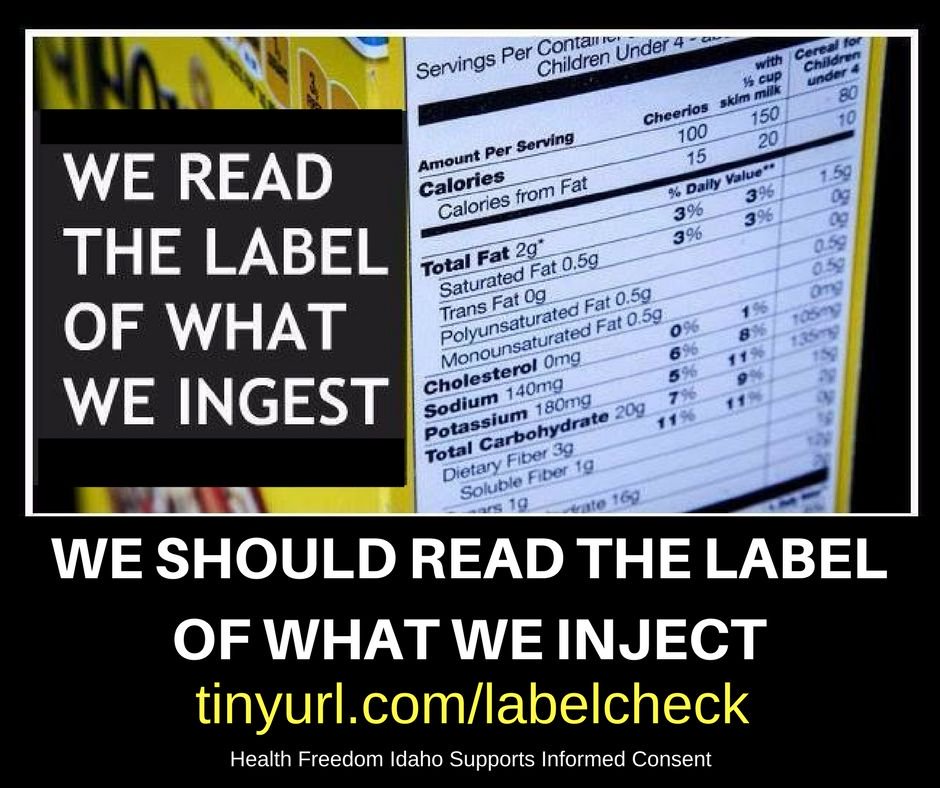
  • Label Check: We read the label for what we ingest. Time we did for what we inject.

    Label Check: We read the label for what we ingest. Time we did for what we inject.

    Informed Consent is the permission granted in the knowledge of the possible consequences, typically that which is given by a patient to a doctor for treatment with full knowledge of the possible risks and benefits. Health Freedom Idaho supports a individual’s right to informed consent and vaccine choice for families.  

    Find out about the common ingredients of vaccines, including formaldehyde, thiomersal, mercury, antibiotics, gelatin and adjuvants.

    Discover the ingredients in the vaccines that your doctor recommends. These trace amounts of toxins accumulate in our bodies causing devastation to our health. 

    Vaccine Ingredients and Manufacturer Information
    (alphabetical order by vaccine)

    I. VACCINES AND INGREDIENTS read vaccine inserts
    1. Adenovirus
    24. Polio
    25. Rabies
    27. Rubella
    31. Typhoid
  • Vaccine Manufacturers GUILTY of FRAUD

    Vaccine Manufacturers GUILTY of FRAUD


    Should we be concerned? Every US Manufacturer/supplies of pediatric vaccines has pled GUILTY to fraud within the last 5 years.

    PRINTABLE FRAUD FINDINGS for Each Vaccine Manufacturer
    US Vaccine Manufacturers as listed by the CDC

    • MERCK: 
      “Merck has been involved in a long federal lawsuit with allegations of fraud over the mumps portion of the MMR vaccine, in a case filed back in 2010 by two whistleblowers, virologists who worked for Merck. Merck has apparently tried hard to get this case thrown out of court, and keep this news out of the media, but late in 2014 a federal judge finally ruled that the case is to move forward.” more
    • United States of America vs. Merck (2:10-CV-04374-CDJ) is a current case in which former virologists, now whistleblowers, allege Merck falsified data with regards to the efficacy of the MMRII vaccine. 

    Sanofi-Aventis US LLC is facing a consumer fraud class action lawsuit kickbacks and over billingNY Times reports:

    Wall Street Journal: Did Merck Unfairly Monopolize the Market for a Mumps Vaccine?
    “The ultimate victims here are the millions of children who, every year, are being injected with a mumps vaccine that is not providing them with an adequate level of protection,” the lawsuit filed by the virologists states. And while federal health officials have said the disease was supposed to have been eradicated by now, “the failure of Merck’s vaccine has allowed this disease to linger with significant outbreaks continuing to occur.” Meanwhile, the mumps vaccine was ringing the register at Merck, which reported that sales reached $621 million last year, when including both the MMR II vaccine – which is mumps, measles and rubella – and the ProQuad vaccine, a combination product that is also used to thwart chickenpox, according to a filing with the U.S. Securities and Exchange Commission.

    UNITED STATES OF AMERICA et al. v. MERCK & CO.
    Pennsylvania Eastern District Court, Case No. 2:10-cv-04374-CDJ
    District Judge C. DARNELL JONES, II, presiding

    Concerned Citizens of California OPPOSE SB277, which mandates a rigid vaccine schedule for ALL children who do not possess a medical exemption.

    United States of America vs. Merck (2:10-CV-04374-CDJ) is a current case in which former virologists, now whistleblowers, allege Merck falsified data with regards to the efficacy of the MMRII vaccine. 

    #CDCWhistleblower #VaxFraud 

    Quantcast