Author: Health Freedom Idaho

  • We are the Informed Dissent Movement

    Unavoidably Unsafe is Unacceptable. We do NOT consent in fact, we dissent.

    What product has grown from approximately $1 billion in revenue in 2001 to $27 billion in 2009 and now $59.2 billion projected for 2020? 

    This product also enjoys 100% liability protection. 

    This same product does not have to dip into revenue to fund a program to pay for injuries it creates (but is not liable for).

    Do you know what I’m talking about? One guess. Vaccines.

    Simply put, no pharmaceutical executive is weighing the cost vs. benefit of creating a safer vaccine. Or losing sleep over a “hot lot.” No doctor is worrying about how long the Gardasil vaccine was tested for safety, or its horrible track record. Not. Their. Problem. 

    Congress, in 1986, erased that worry from their balance sheet. So you’ve got an industry making a TON of money from a product that has 100% liability protection. And that protection extends to the folks that administer those vaccines. 

    Vaccine Injury Court has paid out $4 BILLION to families suffering injury or death of a loved one as a direct result of vaccines. This money comes from a TAX made on each vaccine.

    How did this happen?!

    You see, in the 1980s a lot of kids were having adverse reactions to the DTP (diphtheria, tetanus and pertussis) vaccine. Lots of lawsuits were being filed against docs and vaccine manufacturers. This caused the pharmaceutical industry to make noises about pulling out of the vaccine market, and the alarm bells rang that the nation’s health and safety were at risk. 

    Why were vaccine manufacturers getting ready to take their ball and go home? Because vaccines fall into a class of products considered “unavoidably unsafe.” I am not kidding you. This “unavoidable” word comes from the National Childhood Vaccine Injury Act itself “products which, in the present state of human knowledge, are quite incapable of being made safe.” So they TRIED, but sorry, they just can’t come up with vaccines that are safe enough that their risk department will allow them to sell them. Because a HUGE PHARMACEUTICAL COMPANY sees that even THEY do not have enough money to cover all the expense of fighting and paying injured vaccine recipients. 

    This is an industry that today spends over $200,000,000 A YEAR in lobbyists. Which puts it way ahead of the oil industry in terms of lobbyist expense. (source)

    So the Congress passed the National Childhood Vaccine Injury Act (that title alone points to fact that vaccines can injure children) in 1986. This releases all manufacturers and administers of vaccines from all liability from any injury caused by a vaccine. 

    Then an interesting thing started happening . . .

    It’s not about our health – its about their wealth. 

    excerpt from an article on Thinking Moms Revolution:

  • Importance of Staying Active as a Senior

    Dr Karlfeldt of the Meridian based Karlfeldt Center says that researchers have discovered that the production of hormone FGF21 (responsible for aging) can be reduced with exercise. This hormone also supports the secretion of immune boosting endorphins, detoxification, and healthy blood sugar levels and bones. Exercise is one of several components needed to support health and wellness as we grow older.

    In this interview Dr. Michael Karlfeldt speaks with former Star Mayor about staying active and growing old gracefully. 

    This article was contributed by Jacob Edward,manager of Senior Planning and ALTCS in Phoenix, Arizona

    When people stop exercising, especially as they get older, their risk goes up for partially preventable ailments such as heart disease, obesity, and high blood pressure. The good news is that a little bit of daily exercise can go a long way. 

    Although exercise may seem difficult when you’re just starting out, each time you approach the activity it becomes easier and easier. For older people, small amounts of exercise can lead to major results.

    Try starting out by setting aside 10-20 minutes a day for activity. 

    Activities can include anything from walking a specific distance (even in a mall or grocery store), to doing mild aerobics or light housework/yard work. Once exercising begins to get easier, add on additional activities and extend the time doing them. Additional activities can include doing household chores such as cleaning the house, walking up and down stairs rather than taking an escalator or parking a little further away from the store than usual. Make sure the workout program is a good fit. 

    Depending upon what you and your doctor’s goals are, make sure you actually enjoy working out. 

    The biggest way to kill a workout program is to not have fun while doing it. It’s difficult to motivate yourself when you dread the workout activity. If you enjoy hanging out with friends it might be a good idea to incorporate a walk into the hangout time or if you enjoy activities like dancing or other sports, these are what you should be focusing on. Furthermore, there are many group fitness classes and when participating in a class, many people hardly notice they are completing the recommended amount of weekly exercise. It makes things less tedious and obligatory. For those more advanced in age, additional activities can include doing household chores, walking up and down stairs rather than taking an elevator, or even parking a little further away from the store than usual. All physical activity helps.

    One often-unexplored avenue to achieving fitness is volunteer work. 

    Places like hospitals keep their volunteers pretty mobile. You may be engaged in activities such as showing a patient or visitor to the right area of the hospital, delivering flowers, or bringing gifts. Volunteer work can be a great way to not only get the exercise you need, but also to become a positive asset to your community.

    Like any type of adjustment to your daily routine that affects your health, it is important to consult your physician. Your doctor should help you create a plan that best serves your needs. Form goals and make an approach to achieve those goals in the quickest and safest way possible. Stay in touch with your physician and always mention things like prolonged soreness, pain, or other negative changes. Keep in mind that overdoing it, especially for an older person who hasn’t been very active recently, isn’t the best approach.

    Contributed Article by Jacob Edward,manager of Senior Planning and ALTCS in Phoenix, Arizona. Senior Planning has helped numerous families navigate complicated terrain of long term care, guiding people towards the many available senior services in Arizona

  • Sitting in Silence Proven to Improve Chronic Conditions

    Mediation tends to imply ‘religious’ practices. However, Dean Sluyter explains that it is simply sitting quietly and intentionally. Meditating has been found to be beneficial for improving a variety of conditions including high blood pressure, stress, heart disease, insomnia, depression, anxiety, chronic pain management, drug and alcohol addiction. even AIDS and cancer patients. Although it was once considered an alternative treatment method, meditation is now not only acceptable but encouraged by a variety of traditional physicians, hospitals and health care centers.

    You learn to savor the quiet. It’s something most of us don’t have, quiet, and it takes some getting used to. When we’re driving our cars or out exercising or eating or working, we have music playing or we talk with people or we have the television on. Quiet can be amazing, though, because it helps us calm down, contemplate, slow down to savor the emptiness. 

    Stress and anxiety are known factors in causing pain, physical and emotional. A healthy lifestyle starts with a mindset – we need to slow down. Meditation is intentionally putting a pause in an very busy lifestyle. – Michael Karlfeldt

    In Zen and the Brain, Dr. James Austin tells us that meditation actually rewires the brains circuitry. This theory has been confirmed with imaging techniques that record brain activity.

    In another study published in the American Medical Associations Journal – Hypertension, researchers reported that meditating was just as effective for controlling high blood pressure as prescription drugs.

    While a study at the Stress Reduction Clinic at the University of Mass. by Jon Kabat-Zinn, M.D. reports that participants were able to reduce chronic pain by more than 50 percent. The participants in this study also experienced an increased ability to perform their daily activities and long-term improvements in mood.

    In another study by psychologist, Dr Gregg Jacob at Harvard University, found that 75 percent of people with long-term insomnia were able to falls asleep within 20 minutes after retiring with the
    use of meditation and relaxation.

    In a five year study by Dr. James Blumenthal of Duke University, participants with heart disease were able to reduce their risk of having a second heart attack by 74 percent using meditation, compared to participants who were using prescription medication.

    Aside from specific health conditions, meditating is one of the most effective methods for reducing and managing stress and achieving relaxation, which is something we can all benefit from.

    Learn More About Meditation from Dr. Michael Karlfeldt and Dean Sluyter.

    Natural Meditation: Balance for Mind and Body

  • 4 Ways To Keep Monsanto Out Of Your Home Garden

    Monsanto/Bayer has been proven to knowingly falsifying documentation about the severity of harm their products cause humans and the environment. In 2019  punitive damages were ordered by the court as the jury found that Monsanto “engaged in conduct with malice, oppression or fraud committed by one or more officers, directors or managing agents of Monsanto”  who were acting on behalf of the company.  Evidence laid out in three trials included numerous scientific studies that showed what plaintiffs’ attorneys said was proof Monsanto’s herbicides can cause non-Hodgkin lymphoma. As well, the attorneys presented jurors with many internal Monsanto communications obtained through court-ordered discovery that show Monsanto has intentionally manipulated the public record to hide the cancer risks. 

    We home gardeners need to do our homework to make sure we purchase seeds from companies that aren’t in partnership with Bayer-Monsanto-Seminis. 

    It’s pretty important to make sure that none of the seeds you buy this year support Monsanto or one of the companies owned by them.  

    40% of US seed market is own by Monsanto GUILTY OF FRAUD and MALICIOUS HARM

    In 2005, Monsanto grabbed 40% of the U.S. seed market and 20% of the global seed market when it bought out Seminis, making them the largest seed company in the world. They supply the genetics for 55% of the lettuce on U.S. supermarket shelves, 75% of the tomatoes, and 85% of the peppers, with strong holdings in beans, cucumbers, squash, melons, broccoli, cabbage, spinach and peas! (source)

    And Monsanto has been buying up every seed company they can ever since. By going to the Seminis site, you can see their history of acquisitions. You can see Syngenta and Dow are doing the same.

    Apparently, Monsanto is now legally registered or established to hold the trademark for a plethora of the named heirloom seed varieties. (See a list of names below.) This company has strategically positioned itself to profit from the growing heirloom or open-pollinated home-gardening market.

    4 Ways To Keep Monsanto Out Of Your Home Garden. Seed industry and ownership chart

    (source) Click here for zoom.it (scroll in and out version)

    Bayer, Monsanto and Their Terrible Little Secrets

    First, as of “2015, the Bayer takeover of Monsanto merges a chemical giant with a seed giant and leaves the control of the world’s food supply in too few hands. The merger also links two key parts of agricultural production, reducing competition in the food chain. Bayer is now expected to control 29 per cent of the global seed market and 24 per cent of the global pesticide market.  

    Global seed market is projected to witness a CAGR of 7.82% during the forecast period to reach a total market size of US$99.041 billion by 2022, increasing from US$67.970 billion in 2017. (source)

    “Second, there are serious concerns about increased farmer dependency on a smaller number of suppliers, and higher prices due to weak competition. 

    “Third, the deal increases the power of an even smaller group of companies over the intellectual property, and patents that already lock up much of the world’s commercially produced food supply. The patents weaken farmers’ ability to use and reuse their own seeds.”

    “Finally, there are ongoing food health and safety concerns related to the seeds and chemicals produced by these companies. Increasing their market share increases their power over the market and over the producers and consumers that use their products. In 2015, the World Health Organisation declared glyphosate, the active ingredient in Monsanto’s herbicide, Roundup, as “probably carcinogenic in humans,””(source). There are THOUSANDS of court cases in the process regarding the carcinogenic components of the pesticide and Monsanto’s malicious cover-up of the harm caused to humans and the environment. You can follow the cases here.

    How long will we tolerate the growing monopolization and genetic engineering of seeds by a monopolistic pesticide company that poses a deadly threat to our health, our environment and the future of our food?

    4 Ways To Keep Monsanto Out Of Your Home Garden. Monsanto's monopoly

    (source)

    4 Ways To Keep Monsanto out of Your Garden: 

    So, it’s pretty important to make sure that none of the seeds you buy this year support Monsanto or one of the companies owned by them.

    Excellent seed companies that are NOT affiliated with Monsanto:

    Our Favorite for the Treasure Valley is a LOCAL Seed-CoOp – SNAKE RIVER SEEDS

    1.) Avoid buying anything from companies that are affiliated with Monsanto or Seminis. You can search the companies they do business with to avoid them as they are potentially compromised. 

    2.) Avoid buying seed or seedlings varieties that are trademarked and owned by Seminis or Monsanto. This includes popular tomato varieties such as ‘Early Girl’, ‘Better Boy’, and ‘Burpee’s Big Boy’, as well as a host of other common home garden varieties like ‘Habanero’ hot pepper and ‘Packman’ broccoli. These are not GMO varieties, but their purchase does profit Monsanto.

    Here’s a list.

    3.) Ask seed companies if they have taken the Safe Seed Pledge and tested their stock for GMOs. Here’s a list.

    Companies with ties: Kitazawa Seed Co., Wildflower Gardening, Jung Seeds, Gardener Supply, Tomato Growers, Territorial Seeds

    4.) Purchase, plant, and save seeds from heirloom varieties. We need to support Snake River Seed CoOp, Rare Seeds, Baker Creek Heirloom Seeds, Seed Savers Exchange, and Clear Creek Heirloom Seeds and others that specialize in heirlooms and that are NOT owned by Monsanto or Seminis. The legacy of Seed Saver’s Exchange is to tell you how to collect and store seeds.


    List of companies that specialize in heirlooms and that are NOT owned by Monsanto or Seminis:USA:

    Note: Always ask questions of a company if you want to verify they are not part of the corporate giant. Things change and companies are under pressure to survive. Some may sell out.

    Let’s boycott all gene-altering companies. Together, we can build a more sustainable world, one garden at a time!

    Adaptive Seeds
    All Good Things Organic (SW)
    Amishland Seeds
    Annie’s Heirloom Seeds
    The Ark Institute
    Backyard Beans and Grains Project
    Baker Creek Seed Co. (Rare Seeds)(MW)
    Beauty Beyond Belief (BBB Seeds)
    Botanical Interests
    Bountiful Gardens
    Crispy Farms
    Diane’s Flower Seeds (she has veggies now, too)

    Deep Harvest Farm and SeedsFamily Farmer’s Seed Co-op
    Farm Direct Seed (Hobb’s Family Farm)
    Fedco Seed Co.
    Garden City Seeds
    Gourmet Seed
    Grow Organic
    Heirlooms Evermore Seeds at Azure Standard
    Heirloom Seeds
    Heirloom Solutions
    High Mowing Seeds
    Horizon Herbs
    Hudson Valley Seed Library
    Humbleseeds
    Growing Crazy Acres
    Ed Hume Seeds
    Irish-Eyes
    J.L Hudson 

    Johnny’s Selected Seeds
    Kitchen Garden Seeds
    Knapp’s Fresh Vegies
     Kusa Seed Society
    Lake Valley Seeds
     
    Landreth Seeds
    Larner Seeds
    The Living Seed Company
    Livingston Seeds
    Local Harvest 

    Mary’s Heirloom Seeds

    MI Gardener Organic Seeds
    Moonlight Micro Farm
    Mountain Rose Herbs
    My Patriot Supply
    Native Seeds  (for the Arid Southwest)
    Natural Gardening Company
    New Hope Seed Company
    Nichol’s Garden Nursery
    Organica Seed
    Organic Sanctuary (SE)
    Peace Seeds
    Peaceful Valley Farm Supply
    Prairie Road Garden
    Renee’s Garden
    Restoration Seeds
    Sand Hill Preservation Center

    Sage Thymes
    Seed for Security

    Seed Treasures
    Seeds Trust

    Seeds Now
    Select Seeds
    Siskiyou Seeds (NW)

    Snake River Seeds (Idaho)

    Southern Exposure
    Sow True (SE)
    Sustainable Seed Co
    Tiny Seeds

    Tomato Bob Heirloom Seeds
    Tomato Fest
    Trees of Antiquity
    Turtle Tree Seed
    Underwood Garden Seeds
    Uprising Seeds
    Victory Seeds
    Vermont Wildflower Farm
    White Harvest Seed
    Wild Garden Seeds
    Wildseed Farms
    Wood Prairie Farm (NE)


    SNAKE RIVER SEED is run by locals is a community/family based business as are many of the remaining smaller seed companies! They work extensively to supply free seeds here at home in school gardens and other educational projects. It is their goal to educate everyone about a better, safer food supply.

    Don’t forget Seed-Savers! Here you can shop hundreds of heirloom, organic, non-GMO vegetable seeds and plants to grow in your garden.

    RESOURCES: 

    The Healthy Home Economist gives us 4 ways to forget Monsanto

    SnakeRiverSeeds

    https://livelovefruit.com/heirloom-seed-companies/

  • If You Have to Pick One Herb for Your Garden, Choose Lavender.

    All lavender is fragrant and fantastic for medicinal, cosmetic, and culinary uses. Lavandula angustifolia, in its many varieties, are low maintenance and drought tolerant plants.  Southern Idaho’s alkaline soils are conducive to growing lavender. . Although lavender can tolerate a variety of growing conditions, this plant thrives best under warm, sunny conditions in well-drained soil. In addition, an alkaline soil rich in organic matter can encourage higher plant oil production, enhancing the fragrance in lavender plants.

    Medicinal Uses 

    excerpt from Wellness Mama

    Originating from southern Europe and parts of Africa, Asia, and India, many ancient and medieval cultures relied on the herb not just for its signature scent but also its pain relieving and sedative properties.

    Thanks to its linalool and linalyl acetate components (which are present even when diffusing), lavender has protective effects shown to:

    • Stabilize mood
    • Improve sleep
    • Soothe nerves
    • Work as an expectorant
    • Balance blood sugar
    • Kill bacteria
    • Relieve pain
    • Speed wound healing

    Proven Benefits of Lavender

    Lavender for Better Sleep

    There’s a reason lavender is used in so many of my DIY creations. It is well known for its ability to relax the mind and improve quality of sleep. In one 2006 study, sleep-deprived college students inhaled either lavender or a placebo. Those who used lavender slept more soundly and felt more refreshed upon waking up.

    More study is needed to determine whether it is safe to use during breastfeeding (it’s generally not recommended at this time), but it’s exciting to see emerging research on how lavender might help women during the crucial postpartum time. Improving postpartum sleep (or what little we mothers get anyway) sounds like a worthy cause to me!

    Lavender for Anxiety and Depression

    On a similar note, many studies show interesting applications for lavender for memory, mood, and overall cognitive function. Just the odor of lavender seemed to help various test groups stay relaxed and focused when asked to do various stressful tasks, or improved their ability to recover feelings of wellbeing after exposure to stress.

    Researchers continue to examine the possibilities for lavender in the treatment of dementia, anxiety, depression, and various neurological disorders.

    (I don’t know if those symptoms bring this to mind for anyone else… but lavender’s soothing effects also make it great for managing PMS!)

    Lavender for Skin Care

    Due to its anti-inflammatory effects and ability to scavenge free radicals, lavender has a place in skin care. As is so common in the health world, controversy surrounds the subject of whether it is a skin irritant or a skin protectant, but this article by Robert Tisserand explains the reasons why its benefits outweigh any risks. (Risks are slight, in his informed opinion).

    Give lavender a try in your DIY beauty routine. Use a quality oil (I like Plant Therapy) and the proper dilution for skin. If there’s any concern about sensitive skin, try a test run on a small spot in the inner elbow.

    Lavender for First Aid and Wound Healing

    Studies (and much anecdotal experience) show that lavender reduces pain and itching from bug bites, bee stings, and even burns. In fact one 2011 study examined the benefits of lavender in healing episiotomies and another 2013 study showed lavender aromatherapy relieved pain after c-section.

    Lavender for Hair Growth

    A 2016 study on mice showed lavender is an effective proponent of hair growth and significantly increased the number and health of hair follicles when applied in proper dilution daily for a period of 4 weeks. The properties make it great for healthy, shiny hair in general. (Recipes for these treatments below.)

    This herb has many benefits here are 5 simple ways to use your harvest

    1. Crush fresh flowers and spread it on your legs & arms to help repel flies & mosquitoes while sitting outside in the summer.
    2. Use lavender in soothing and calming bath salts to relieve tension, stress, and insomnia.  
      To make 12 ounces of Lavender and Rosemary Bath Salts mix these ingredients in a non-reactive bowl or glass jar:
      • 1/2 cup Epsom salt
      • 1/2 cup Dead Sea salt
      • 1/2 cup oatmeal, powdered in a blender
      • 1 tablespoon dried rosemary
      • 1 tablespoon dried lavender buds
      • 1 tablespoon olive oil
      • 8 to 10 drops of lavender essential oil
        Combine the ingredients and mix well. Transfer it to a mason jar with a lid and let it rest for a couple of days so the essential oils are incorporated. Add a handful of lavender bath salts to warm bath water. The Epsom Salts in this recipe help relieve sore muscles and the lavender will help relieve stress. Enjoy!
    3. Make lavender antiseptic spritzer with 1 cup water, 2 tablespoons of lavender infused witch hazel, 5-10 drops of lavender essential oil – all placed in an 8 oz spray bottle.
    4. Make lavender lemonade with this recipe from Small Footprint Family. It uses honey, lemons, and lavender. Simple and scrumptious!
    5. In a tincture – Used for medicinal purposes since ancient times, a lavender tincture can promote relaxation and sleep.

    Resources:

    Read more at Gardening Know How: Lavender In The Garden: Information And Growing Lavender Tips https://www.gardeningknowhow.com/edible/herbs/lavender/lavender-in-the-garden-information-and-growing-lavender-tips.htm

    10 things to make using Lavender: https://thenerdyfarmwife.com/10-things-to-make-with-lavender/

    Lavender Uses from Wellness Mama: https://wellnessmama.com/7041/lavender-uses/

  • We Invite You to Join Us

    Keeping our states safe for health freedom requires SUPPORTING these volunteer organizations. Health Freedom Idaho is a large organization coordinated by a small group of moms many of whom struggle with their own health issues and/or helping their children heal from chronic illness.

    Time, money, energy spent daily in an effort to protect this great state’s liberty and health freedom. It is run by volunteers and yet the organization needs money! Why? Cost for Printing materials to send to legislators, Cost for educational materials and vendor fees for local events (like the Family Poluza), hosting educational events such as the Natural Health Symposium and for the website fees, postage – those everyday expenses add up for the small group of active volunteer leaders who sacrifice time and energy to keep our government in check.

    We invite you to support us! $10 annual membership, $25 monthly donation or a one time gift – used to its full extent to protect your family’s freedom.

  • A Browser Without Tracking, Surveillance, or Censorship

    Thanks to an assist from Congress, your cable company has the legal right to sell your web-browsing data without your consent. This is how to protect your data from preying eyes. As the battle heats up for health freedom and body autonomy people are more aware than ever before of the sort of information they can reveal every time they set a digital footprint on the web.

    If you want to push back against online tracking, you’ve got several options to pick from when choosing a default browser. These are the browsers that put user privacy high on the list of their priorities. 

    DuckDuckGo (Android, iOS, browser extension)

    You might know DuckDuckGo as the anti-Google search engine, but it’s also branched out to make its own mobile browsers for Android and iOS. Not only do they keep you better protected online, they give you plenty of information about what they’re blocking.

    DuckDuckGo starts by enforcing encrypted HTTPS connections, when websites offer them, and then gives each page you visit a grade based on how aggressively it’s trying to mine your data.

    Ghostery (Android, iOS, browser extension)

    Get Ghostery for Android or iOS installed, and straight away it gets to work blocking adverts and tracking cookies that will attempt to keep tabs on what you’re up to on the web.

    Like DuckDuckGo’s mobile apps, the Ghostery browser tells you exactly which trackers it’s blocking, and how many monitoring tools each website has installed—if you find certain sites that are well-behaved, you can mark them as trusted with a tap.

    Or, if you find a site that’s packed full of tracking technology, you can block every single bit of cookie technology on it (for commenting systems, media players and so on), even if the site might break as a result.

    Ghostery also develops an extension that works with just about every desktop browser out there—again, you can view the trackers on each site you visit, then take appropriate action on them or let Ghostery decide and its AI smarts decide what needs blocking.

    Ghostery’s tools are a little more in-depth and advanced than the ones offered by DuckDuckGo, so you might consider it if you want to take extra

    control over which trackers are blocked on which sites.

    Tor Browser (Android, Windows, macOS)

    Tor Browser stands for browsing “without tracking, surveillance, or censorship” and is worth a look if you want the ultimate in anonymized, tracker-free browsing—unless you’re on iOS, where it isn’t yet available.

    The browser app for Android, Windows and macOS is actually part of a bigger project to keep internet browsing anonymous. The Tor Project routes your web navigation through a complex, encrypted network of relays managed by its community, making it much harder for anyone else to work out where you’re going on the web.

    As well as this additional layer of anonymity, Tor Browser is super-strict on the sort of background scripts and tracking technologies sites are allowed to run. It also blocks fingerprinting, a method where advertisers attempt to recognize the unique characteristics of your device across multiple sites, even if they can’t tell exactly who you are.

    At the end of each browsing session, everything gets wiped, including cookies left behind by sites and the browsing history inside the Tor Browser app itself. In other words, private browsing mode is the default.

    Because of the extra encryption and anonymity measures, Tor Browser can run slightly slower than other browsers, but in terms of staying invisible on the web, it’s the best there is. It can even help you get online in countries where the internet is blocked or censored.

    Brave (Android, iOS, Windows, macOS)

    Brave is a project from Brendan Eich, once of Firefox developer Mozilla, and its mission includes both keeping you from being tracked on the web, and finding a better way to serve you advertisements. It’s a dichotomy that doesn’t fully fit together just yet.

    There’s no doubt about the effectiveness of its tracker blocking technologies though. The browser apps block ads by default and put tight restrictions on the information sites can gather on you through cookies and tracking scripts.

    You can block trackers, scripts, and fingerprinting technologies—where sites attempt to identify your particular device—individually, but unlike DuckDuckGo and Ghostery you don’t get a detailed breakdown of what’s been stopped.

    Brave also tries to block phishing attempts over the web, and will force HTTPS encryption where it’s available. It’s a comprehensive package that strikes a well-judged balance between simplicity and power.

    Time will tell whether Brave’s attempts to create a new privacy-respecting ad platform are successful, but it’s testing the idea of paying users to watch ads and splitting the revenue with content creators. You can also give micropayments to sites you like directly, though all of this is completely opt-in.

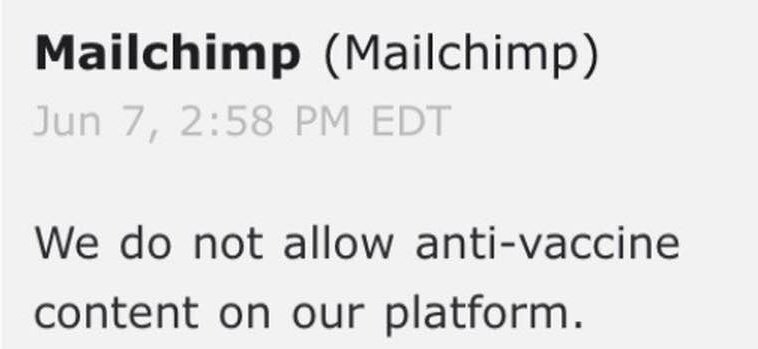
  • Digital Marketing Platform Mailchimp Bans Anti-Vaccination Content

    Digital marketer Mailchimp has removed several health freedom groups from its platform forcing some without access to their membership databases for a period of time. These independent freedom minded groups who pay for membership to the service and have permission from the recipients to receive the emails, will no longer be allowed to use Mailchimp as a form of email contact.

    This block follows a revelation that Mailchimp has partnered with the CDC. 

    Mailchimp has said they are actively screening ALL accounts for anything that resembles liberty in your healthcare decisions! The company began quietly enforcing this decision last week shutting down access to groups such as Wyoming Health Freedom and Colorado Alliance for Vaccine Choice. https://mailchimp.com/announcements/vaccine-misinformation/

    This is an attempt to silence those who call for independently verified science, who point out the proven harmful effects of vaccines on individuals and demand freedom from vaccine mandates. If they had truth and science on their side they wouldn’t need to resort to censorship.

    Earlier in 2019, Amazon pulled ‘anti-vaccination’ documentaries from its Prime Video service and several books from its marketplace. Facebook began to stop advertising and is using ‘fact-checking’ as a form of censorship to reduce the visibility of medically proven and science backed vaccine information shared on its platform. See the ‘fact check’ propaganda reveal by Ashley Everly. 

    YouTube also disabled advertising on “anti-vaccination” videos and lowered in ranking “health misinformation” content in its search results. Pinterest has blocked all vaccine-related search results. Even Etsy has shut down shops of only those who speak against vaccine. Those who produce items that are clearly hate speech exist on the platform. 

    NBC tells the public that these forms of censorship and violations of speech “have come as a shock to anti-vaccination advocates who for years were served well by recommendation algorithms that boosted controversial and conspiratorial content, such as the underlying and discredited notion that vaccines cause autism, a unifying theory for anti-vaccination groups.”

    The spread of truth and information started to strengthen with the advent of social media. It surged to massive proportions with the initiation of school mandates in California in 2015 and continues to spread even in the midst of this ‘outbreak of censorship.’
    Could this be because the truth is on the side of those who question vaccine safety? 

    Three things cannot be long hidden: the sun, the moon, and the truth.

    Health Freedom Idaho has already moved to a new platform and our readers, subscribers are encouraged to sign up and stay informed. 

  • Lemon Balm. 5 Uses For This Easy To Grow Herb.

    In southern Idaho the lemon balm is full and ready for harvest. If you’ve ever planted lemon balm you know how one tiny plant can quickly take over a large portion of your garden! Hint: Lemon Balm is a perennial. Plant lemon balm in a pot as it will spread (and take over your garden). The herb thrives in full sun, but can be grown in partial shade. Lemon Balm can be grown in most areas of the United States, US hardiness zones 4-9.

    This herb that not only attracts bees to the garden, but is also a great anti-viral with relaxing properties that are helpful for soothing frayed nerves and calming hyper children.

    Traditionally, it’s been used to gently treat colic and upset stomach in everyone from infants to elders. A leaf can be chewed to freshen the breath or crushed and placed on a bug bite to help ease the itch.

    Note: While it’s generally considered safe for most people, large amounts of lemon balm may inhibit thyroid function. If you have hypothyroidism (underactive thyroid), are on thyroid medication, or are pregnant, nursing, or have any other questions or concerns, talk with a qualified health professional before use. 

    1. Lemon Balm Tea
    This is a delicious way to calm and relax everyone from children to adults!

    • Place about 3/4 cup lemon balm leaves into a small pot and add enough water to just cover the leaves.
    • Simmer, covered partially, until the liquid is reduced in half.
    • Strain out & compost the leaves.
    • While still quite warm, measure out about 1/2 cup of the concentrated tea and stir 1/4 cup raw honey into it.
    • Add more honey to taste, if you wish.
    • Store in the refrigerator for about 3 days.
    • Dose by the spoonful at night to help calm and relax. (Honey should not be used with children under 1 year old.)

    Note: You can make larger or smaller batches – keeping a ratio of about 2 parts lemon balm infusion to 1 part honey.

     2. Make a lemon balm bug spray:

    I’ve tried a lot of homemade bug spray recipes and this is my favorite one.

    The best part is that it’s yet another way to help use up some of my abundance of lemon balm and other herbs!

    You can find the full recipe and how to make it in this blog post, Lemon Balm Bug Spray.


    3. Chop fresh leaves and sprinkle on salads or in baked goods:

    Drizzle the salads with honey or a dressing made of yogurt and honey.

    Try adding finely chopped leaves (1 to 2 TBSP) and lemon zest (a pinch) to your favorite scone or muffin recipe.

    Fresh leaves can also be frozen in ice cubes to dress up a summer beverage.

    4. Make a lip balm for cold sores:

    This lip balm recipe was designed especially for my son who developed cold sores triggered by sunshine when he was young.

    It cleared his cold sores up within a few months and they stayed away!

    You can find the full recipe and how to make it in this blog post, Super Healing Cold Sore Lip Balm.

    5. Make a glycerite:

    Glycerites are a sweet way to dose herbal medicine without the alcohol that regular tinctures contain. Herbal infused glycerin can also be used as an ingredient in lotions, toners and aftershave recipes.

    To make a lemon balm glycerite:

    • Fill a jar with lemon balm leaves.
    • Cover with a mixture of 3 parts vegetable glycerine to 1 part water.
    • Cap and let this sit in a dark place for 3 to 4 weeks.
    • Strain.
    • Dose is 1/2 to 1 teaspoon as needed to relax and calm.
    • Store in your refrigerator for several months.

    (Adapted from Rosemary Gladstar’s Medicinal Herbs.)

    Lemon Balm is also a star ingredient in this trusted Favorite Cold & Flu Tincture.

    Find a Dozen Great Uses at thenerdyfarmwife.com

    Print Friendly, PDF & Email
  • Facebook Fact Check Equals Manipulated Masses

    Facebook is not only censoring information, they are replacing it with blatant lies created and manipulated to replace factual, objective, honest data. HFI ENCOURAGES our readers to fact-check for themselves. We have included medical journals and scientific resources that clearly contradict the censorship of ‘Facebook Fact-Checkers’.

    You know they’re trying to manipulate the masses and keep people believing BLATANT LIES, when they’re putting so much effort into censorship. – Ashley Everly

    Current data shows that vaccines are safe and do not cause toxicity or encephalopathy…except when you look at medical journals and vaccine inserts.

    Acute encephalopathy following TDAP vaccination:

    https://pdfs.semanticscholar.org/…/6a24ee73c82604cdfb19…

    Acute encephalopathy followed by permanent brain injury or death associated with further attenuated measles vaccines:

    https://www.ncbi.nlm.nih.gov/m/pubmed/9481001/

    HHS Vaccine Injury Table:

    https://www.hrsa.gov/…/vaccineco…/vaccineinjurytable.pdf

    The FDA links to actual manufacturer’s vaccine inserts: https://www.fda.gov/vaccines-blood-biologics/vaccines/vaccines-licensed-use-united-states

    Other resources for your ‘fact-checking’ research: 

    https://www.ncbi.nlm.nih.gov/pmc/articles/PMC4717322/

     The denial is getting stronger every day. Like the cigarette companies once did. https://www.ncbi.nlm.nih.gov/pmc/articles/PMC3490543/

    HFI isn’t going to last much longer on Facebook – we are already in an echo chamber. 11,000 people follow our page less than several hundred see our posts.  Don’t trust FACEBOOK for your facts! Explore the internet. Use DuckDuckgo for your search engine – you find resources that google hides.