Category: Toxins

The facts about chemicals, pesticides, and clean water.

  • Fragrance Is The New Secondhand Smoke

    Fragrance is the New Secondhand Smoke | Branch Basics 
     
    Surely you’re familiar with one of these scenarios: The Scented Candle That Won’t Go Away

    You walk into a store full of scented candles. They smell so fresh and lovely, but a few minutes later, your nose starts to itch and you are starting to get a headache. You notice that you’re having a harder time focusing on anything and you start to feel light-headed.  You end up buying a candle and leaving, feeling better as soon as you walk out the door. A few days later, the smell of your new candle is on everything: your coat, your car, the living room – even when it’s not lit. The headache just won’t go away and you start to feel worn down and tired.

    The Mist That Never Disappears

    You spray a fine mist of air freshener all over that musty pile of backpacks in the mudroom. Your second-grader grabs his bag, now slightly wet and sweet-smelling, and starts to do homework, but is having trouble focusing. He’s getting a headache and starting to whine about wanting to play outside. Meanwhile, the fake scent of flowers dissipates as it numbs sensory receptors in your nose and starts driving your puppy a little crazy. Eventually, you can’t smell it anymore, but you’ve ingested it through your nose, lungs, and skin.

    Fragrance Is the New Secondhand Smoke

    If you’ve experienced anything like this and connected the dots, you know how insidious synthetic fragrance can be. It’s only human to seek out pleasant smells and to try to eliminate unattractive scents from our environments. However, the immediate and long-term effects of synthetic  fragrance exposure is hazardous to our health. Simply adding a pleasant smelling chemical to our bodies and air will not only affect our own health, but the health of the people (and pets!) who share the air with us.

    What’s Actually in A Fragranced Product?

    Today, fragrance is the elephant in the room. “Fragrance” or “parfum” on an ingredient list actually represents a trade secret fragrance recipe that could be made up of not just one or two chemicals, but hundreds of synthetic chemicals.4 These chemicals are selected from a reservoir of 5,000 ingredients.5 And of this large number of ingredients, none of them actually have to be disclosed or tested for safety.6

    According to an Environmental Working Group (EWG) study, 72% of products with the ingredient “fragrance” contained endocrine disruptors called phthalates.7 Phthalates have been linked to diabetes, obesity, liver and breast cancer, hormone disruption affecting fertility and development as well as linked to ADHD and Autism in first and third trimester prenatal exposure. The National Academy of Sciences, working with an expert panel, stated that there may be cancer-causing chemicals in fragrance recipes.8 Unfortunately, because of secrecy and a lack of transparency in labeling, there is really no way for a consumer to make informed decisions about fragranced products.9

    Up to 95% of these the synthetic chemicals used to make fragrance recipes are derived from petrochemicals.10 These particular ingredients are known (according to a 1991 EPA analysis) to cause cancer, birth defects, nervous system disorders, asthma, and allergies.11 To make matters even worse for the unsuspecting public, many products labeled as “unscented” are actually the fragranced product with the addition of another masking fragrance.12

    What about Natural Fragrance or Essential Oils?

    Unfortunately, the term “natural fragrance” or “essential oil” on an ingredient list does not necessarily mean it is safe. In a study analyzing 25 top selling products, researchers found that the “green”, natural, and organic fragranced products emitted just as many hazardous chemicals as regular fragranced products.13 That’s because most essential oils in consumer products are processed with a toxic solvent. In addition, essential oils containing terpenes such as pine and citrus oils react with ozone in surrounding air to create secondary pollutants such as formaldehyde, acetaldehyde, acetone, and ultrafine particles.14 To ensure safety, essential oils in products should be verified as organic and wildcrafted and extracted without solvents. 15, 16

    How can we help protect the public?

    Fragranced products  are harmful to our health. Babies, children, the elderly, and those with cancer or other chronic illness are particularly at risk. The current demand for products that  “smell good” reflects the misinformed innocence of consumers. Awareness of this issue is in its infancy, but the good news is that action is already being taken to pave the way in educating and protecting the public. The American Lung Association has created a fragrance-free policy for workplaces and for schools. Harvard University teaching hospital is a model for promoting fragrance-free policies in their hospital.17 Brigham and Women’s Hospital has even initiated a campaign for fragrance-free health care.

    The best way for individuals to influence the fragrance industry is at the cash register – this will ultimately provide the impetus for change in the marketplace.  Be proactive and only buy products that are unscented or have pure, safe essential oils. Even just removing all products with fragrance as an ingredient will immediately improve air quality in your home.  Take charge of your family’s health and wellbeing – ditch these synthetics! 

    Clean Up Your Act Branch Basics: Fragrance is the New Secondhand Smoke

    Join us to Clean Up Your Act. We are pledging the following:

    1. Don’t Buy Fragranced Products (unless contain pure organic essential oils)
    2. Ditch All Synthetic Fragrances
    3. Invest in Fragrance-Free, Nontoxic Alternatives

  • A new generation of water pollutants in your medicine cabinet

    Every day, we each use a variety of personal care products. We wash our hands with antibacterial soaps and clean our faces with specialty cleansers. We wash and maintain our hair with shampoo, conditioner and other hair care products. We use deodorant and perfume or cologne to smell nice. Depending on the day, we may apply sunscreen or insect repellent.The Conversation

    But where do they go after we use them?

    When we bathe, personal care products wash off of our bodies and into sewer systems that carry them to regional wastewater treatment plants. However, these plants are not designed to treat the thousands of specialty chemicals in pharmaceuticals and personal care products. Many of the active and inactive ingredients present in these products pass through our wastewater treatment plants and ultimately end up in rivers, streams or oceans.

    Once in the environment, these chemicals may cause hormonal effects and toxicity in aquatic animals. In my laboratory, we are studying these emerging water pollutants, which are turning up in surface water, groundwater and even treated drinking water. Although they are typically found at low concentrations, they may still threaten human and ecological health.

    New pollutants, present worldwide

    Personal care products and their ingredients are widely distributed throughout our environment. In one recent study, our lab aggregated more than 5,000 measurements of active ingredients from a variety of personal care products that were found in untreated wastewater, treated wastewater and surface waters such as rivers and streams. They included N,N-diethyl-3-methylbenzamide, or DEET(an insect repellent); galaxolide(a fragrance); oxybenzone(a sunscreen); and triclosan(an antibacterial compound).

    Other studies conducted near the Mario Zucchelli and McMurdo & Scott research bases confirmed that chemicals in personal care products were even present in Antarctic seawater. Those reports identified the presence of plasticizers, antibacterials, preservatives, sunscreens and fragrances in the Antarctic marine environment. Together, these studies suggest that the active ingredients in personal care products can be found in any water body influenced by human activity.

    These substances are typically present in the aquatic environment at concentrations of 10 to 100 nanograms per liter, which is equivalent to 1 to 2 drops in an Olympic-sized swimming pool. But even at these low levels, some still pose a risk.

    Moving up the food chain

    Depending on their chemical properties, we can classify some of these products as hydrophilic (“water-loving”) or lipophilic (“lipid-loving”). The fat layers in our bodies are comprised of lipids, so lipophilic personal care products can accumulate in the tissue and organs of aquatic animals like fish, birds and even dolphins.

    Our group has recently detected a suite of sunscreen agents and 17α-ethinylestradiol, a synthetic form of the hormone estrogen that is the active ingredient in birth control pills, in crayfish from urban streams near Baltimore, Maryland. We have also measured sunscreens in oysters and mussels collected from the Chesapeake Bay. The uptake of these chemicals by aquatic animals raises environmental concerns.

    Specifically, as lipophilic chemicals from personal care products accumulate in animals at higher concentrations, there is a greater potential for them to cause toxic effects. For instance, many personal care products disrupt hormone systems in the body. Some chemicals used in personal care products affect reproductive systems and function, causing the feminization of male fish.

    These reproductive effects can have important consequences for aquatic animals in the environment, and they may even represent a potential health risk for humans. Last year, the Food and Drug Administration banned the use of triclosan and a number of other antibacterial agents in antiseptic wash products due, in part, to health risks associated with hormonal effects.

    Recent research has shown that oxybenzone, a sunscreen agent used in many personal care products, is toxic to corals. For many coastal communities, coral reefs are critical to local economies. For example, the net value of Hawaii’s coral reefs is estimated to be $34 billion.

    Earlier this year Hawaii introduced legislation to ban the sale of sunscreens containing oxybenzone and octinoxate in order to protect coral reefs. While research and policymaking are still ongoing in this area, it is important to note that a number of new consumer products have started using labels like “coral safe” and “reef safe.”

    Multiple solutions

    Typical wastewater treatment plants are designed to treat multiple pollutants, including organic carbon from human and food waste; nutrients like nitrogen and phosphorus; and pathogenic bacteria and viruses that cause disease. However, they are not equipped to handle the many ingredients of concern that are present in personal care products.

    Protecting the environment and human health from these substances will require progress in several areas. They include improving technologies for wastewater treatment plants; conducting more testing and regulation of personal care products to avoid unintended toxicity to aquatic animals; and designing “green chemicals” that do not pose toxicity concerns. This multi-pronged approach will help us to ensure that personal care products continue to improve our quality of life without harming the environment.

    Lee Blaney, Assistant Professor of Environmental Engineering, University of Maryland, Baltimore County

     Read the original article.

    .

  • Commerical Hand Sanitizers Puts 10x more Chemicals IN your body


    You use hand sanitizer to keep dangerous germs out, but you’re really inviting toxic chemicals in. Research proves that the active ingredient in hand sanitizer is an endocrine disruptor(1), easily absorbed through your skin, and might be linked to cancer. Its name? Triclosan. 

    Hand sanitizer companies use triclosan as an antibacterial agent; it is, after all, effective in killing many types of bacteria. Triclosan is also used in other hygienic products such as toothpaste and soaps. On the label, it may also be called (2): 

    • Aquasept
    • Irgasan DP 300
    • Microshield T
    • Sapoderm
    • Tersaseptic
    • Trisan
    • Manusept

    Health Dangers of Triclosan

    While triclosan has yet to be classified as a confirmed human carcinogen, scientists have suggested potential links to hormone-related cancers such as breast cancer, ovarian cancer, and prostate cancer (4). As an endocrine disruptor, triclosan interferes with the body’s normal hormone systems- sometimes with deadly effects. 

    HM Lee, head researcher of a 2016 scientific paper writes, “the majority of previous studies revealed that BPA, phthalates, TCDD, and triclosan have the potential to induce cancer metastasis…the exposure to these EDCs [endocrine disrupting chemicals] can increase the risk aggravating the disease for the patients suffering cancer and that more regulations about the use of these EDCs are needed,” (4). 

    But can these risks really come from using hand sanitizer? The answer, unfortunately is yes. Research shows that triclosan can be easily stored up by your body over time. A 2016 study uncovered that triclosan was found in both water supplies and in humans- in blood, urine, breast milk, and even nails. Head researcher LWB Olaniyan states that this bioaccumulation of triclosan in the body is a cause for concern, especially since triclosan ” is a pro-oxidant and may be cytotoxic via a number of mechanisms,” (1).

    The dangers aren’t just for adults who make a habit of using hand sanitizers over the years. There is a “window” of time that makes young, developing children more susceptible to the effects of endocrine disrupting products. A 2016 study done on rats raised concerns about children’s and adolescents’ use of personal products containing triclosan (as well as other dangerous additives like phthalates). Head researcher  Sander Houten writes about the potential dangers for humans: “the prepubertal stage is the most sensitive window of opportunity for these personal care product ingredients,” (3). 

    The Most Effective Homemade Hand Sanitizer from http://www.healthy-holistic-living.com

    The truth is you don’t need an antibacterial soap or product to protect yourself from harmful germs! In a 2007 study, scientists proved that soaps containing triclosan were actually no more effective at reducing bacteria and preventing infections than regular soap. Not to mention, many strains of bacteria had evolved to be immune to triclosan’s antibacterial effects anyway (5). 

    The bottom line is you don’t need to waste money on toxic hand sanitizers to stay health- all you need is a bar of soap to keep your hands clean. However, if you’re looking for a natural antibacterial to carry around with you, you can easily make your own “sanitizer” out of essential oils and natural ingredients. 

    Eucalyptus and tea tree essential oils are proven antimicrobials (without being toxic or endocrine disrupting) (6). They can easily be mixed with natural aloe vera gel, another antibacterial agent (7). Aloe also has the added benefit of being naturally soothing, able to reduce skin redness, and even increase skin elasticity (8,9).

    Ingredients:

    • 1/4 cup Aloe Vera Gel
    • 10 Drops of Tea Tree Oil
    • 10 Drops Eucalyptus Oil 

    Instructions:

    1. Mix all ingredients together.
    2. Pour into a spray bottle or a pump type bottle.
    3. Shake before applying

    Always do a “spot test” using a small amount of the essential oil mixture to test for skin irritation. Cinnamon essential oil is an especially common irritant. 

    Sources:

    1.https://www.ncbi.nlm.nih.gov/pmc/articles/PMC5031584/

    2. https://pubchem.ncbi.nlm.nih.gov/compound/triclosan#section=Wikipedia

    3. https://www.ncbi.nlm.nih.gov/pmc/articles/PMC4965097/

    4. https://www.ncbi.nlm.nih.gov/pubmed/28042023

    5. https://www.ncbi.nlm.nih.gov/pubmed/17683018

    6. https://www.ncbi.nlm.nih.gov/pubmed/27790572

    7. https://www.ncbi.nlm.nih.gov/pubmed/28050502 

    8. http://www.ncbi.nlm.nih.gov/pmc/articles/PMC4078333/

    9. http://www.ncbi.nlm.nih.gov/pmc/articles/PMC2883372/

    Of course, there are other recipes for DIY Hand Santizer. Want to share your favorite, do so in the comments! 

  • Autism Meltdown. What should WE do?

    I saw an autistic meltdown in the middle of the grocery store today. Yes, it was autism, flapping arms, squaking nosies, ears covered and the mostly grown boy squatting on the cold floor rocking back and forth. Most pretended as if it wasn’t happening. I locked eyes with the mother briefly, and felt a very lost and exhausted sense. My heart broke for her. She attempted to quiet him and leave the store as quickly as possible.

    Simple things, that we all take for granted. Grocery shopping in a store with bright lights that might trigger a child’s sensitivity. Or loud noises, that might send a child into a downward spiral. Or to many people surrounding, that might cause him to become sensory overloaded. I imagine this mother now knows the “not so busy” times to visit the grocery store, with her autistic son, to keep the over stimulation as minimal as possible.

    This life.
    This life that now has become one hundred times harder than most can ever even fathom.

    Do you still think autism is a gift?

    Autism Moms I would like to know – what can we do to help you in a store – when this situation arises? 

  • Evidence that Agricultural Pesticides and Other Toxic Chemicals Are Poisoning Us

    Two new reports published in recent weeks add to the already large and convincing body of evidence, accumulated over more than half a century, that agricultural pesticides and other toxic chemicals are poisoning us.

    Both reports issue scathing indictments of U.S. and global regulatory systems that collude with chemical companies to hide the truth from the public, while they fill their coffers with ill-gotten profits.

    According to the World Health Organization, whose report focused on a range of environmental risks, the cost of a polluted environment adds up to the deaths of 1.7 million children every year.

    A report by the Special Rapporteur on the right to food, presented to the United Nations Human Rights Council, focused more narrowly on agricultural chemicals. The UN report states unequivocally that the storyline perpetuated by companies like Monsanto—the one that says we need pesticides to feed the world—is a myth. And a catastrophic one at that.

    The fact that both these reports made headlines, in mainstream outlets like the Washington Post and the Guardian, is on one hand, good news. On the other, it’s a sad and discouraging commentary on our inability to control corporate greed.

    Ever since Rachel Carson, in her book Silent Spring,so eloquently outlined the insanity of poisoning our environment, rational thinkers have warned that at the least, we ought to follow the precautionary principle when it comes to allowing the widespread use of poisons to be unleashed into the environment.

    And yet, here we are, in 2017, facing the prospect under the most corporate-friendly administration in history, of dismantling what little remains of the government’s ability to stop the rampant poisoning of our soils, food, water and air—the very resources upon which all life depends.

    In his book, Poison Spring: The Secret History of Pollution and the EPA, published in 2014, E. G. Vallianatos, who worked for the EPA for 25 years, wrote:

    “It is simply not possible to understand why the EPA behaves the way it does without appreciating the enormous power of American’s industrial farmers and their allies in the chemical pesticide industries, which currently do about $40 billion per in year business. For decades, industry lobbyists have preached the gospel of unregulated capitalism and Americans have bought it. Today, it seems the entire government is at the service of the private interests of America’s corporate class.”

    That was three years ago. And yet, as public opinion shifts toward condemnation of the widespread use of toxic chemicals on our food, here in the U.S., government officials entrusted with public health and safety appear more determined than ever to uphold the “rights” of corporations to poison everything in sight—including our children.

    Exposure to Pollution Kills Millions of Children, WHO Reports Find

    According to the WHO reports, which focused on a wide range of chemicals, including those found in food, electronics, contaminated water supplies, second-hand tobacco smoke and others, one-fourth of all children’s deaths and diseases in 2012 could have been prevented by reducing environmental risks. From the WHO press release:

    Children are also exposed to harmful chemicals through food, water, air and products around them. Chemicals, such as fluoride, lead and mercury pesticides, persistent organic pollutants and others in manufactured goods, eventually find their way into the food chain. And, while leaded petrol has been phased out almost entirely in all countries, lead is still widespread in paints, affecting brain development.

    What Will it Take?

    If you find yourself unsurprised by the findings of these reports or the recommendations that follow, it’s no wonder. Many organizations, including ours, have for decades been calling for reforms.

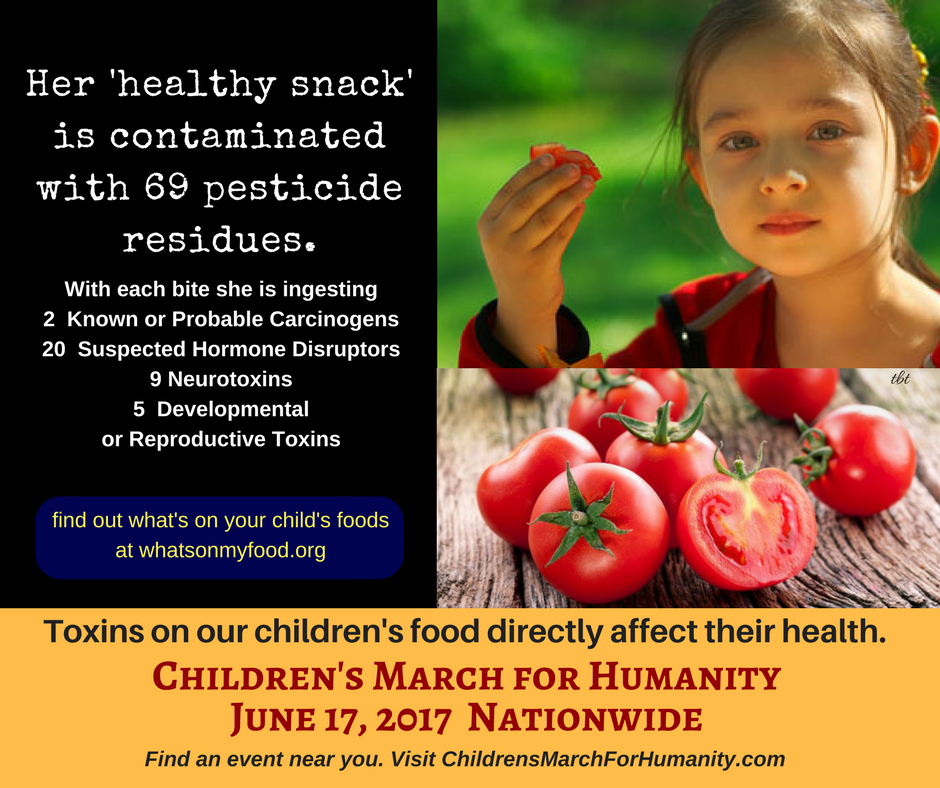
    Join us and 1000’s of other families across the United States calling for a change. RSVP to the Children’s March For Humanity https://www.eventbrite.com/e/childrens-march-for-humanity-boise-tickets-33803789043

    Portions of this article were written by Katherine Paul is associate director of the Organic Consumers Association.

  • EPA Scraps Scheduled Ban of Widely Used Pesticide Known to Harm Kids’ Brains

    In one of his first major decisions as U.S. Environmental Protection Agency (EPA) administrator, Scott Pruitt sided with the pesticide lobby over scientists Wednesday in an eleventh-hour decision to abort the agency’s proposal to ban chlorpyrifos—an insecticide that at small doses can harm children’s brains and nervous systems—from use on food crops.

    Pruitt and the Trump administration’s decision ignored overwhelming evidence that even small amounts of chlorpyrifos can damage parts of the brain that control language, memory, behavior and emotion. Multiple independent studies have documented that exposure to chlorpyrifos impairs children’s IQs and EPA scientists’ assessments of those studies concluded that levels of the pesticide found on food and in drinking water are unsafe.

    In October 2015, the EPA proposed to revoke all uses of chlorpyrifos on food. Late last year, Croplife America—the main trade and lobbying group for the pesticide industry—petitioned the EPA to block the expected ban. In its appeal, Croplife argued that the EPA should disregard the findings of epidemiological studies documenting that the pesticide impaired American children’s IQs and brain development.

    The EPA’s analysis of children’s sensitivity to chlorpyrifos drew upon studies by Columbia University, Mount Sinai School of Medicine and the University of California, Berkeley. In 2007 the Natural Resources Defense Council and the Pesticide Action Network petitioned the EPA to ban food uses of chlorpyrifos and they later sued the agency to compel a ruling on the petition. The EPA proposed the ban in October 2015 and was under court order to issue a final rule by the end of March.

  • Potent carcinogen contaminated drinking water used by millions

    According to a new nationwide Gallup survey, Americans are really worried about contaminants in their drinking water. Nearly two-thirds of Americans have “a great deal” concern about pollution of tap water, and 57 percent worry “a great deal” about pollution of the nation’s rivers, lakes and reservoirs. Concern hasn’t been this high since 2001.

    The worry is well founded Shell Oil Co. and Dow Chemical hid a known cancer-causing substance in two commonly-used pesticides that contaminated the drinking water of millions of people in California, according to lawsuits detailed in a report from the Environmental Working Group earlier this month.

  • Let’s Talk About The Threat of Toxins On Our Children

    HFI: Toxins and Our Kids. Tiny amounts of lead, chemical flame retardants and organophosphate pesticides such as Round Up, among other toxins, course through the blood of nearly every American. But just how much worry is a little poison worth?


    A lot, especially when considering the cumulative effects of this chemical cocktail on children. 
    Our children are a sicker generation than their parents. Neurological issues, Allergies, Ecezma, ADD, Cancer, Delays, Autism, SIDS…could it be that its the toxic environment we created that is causes some or all these issues?  Experts agree on one big problem: We’re not really looking at the long term impact of chemicals on our children. The U.S. Environmental Protection Agency, for example, has only required toxicity testing for around 200 of the more than 80,000 chemicals permitted for use in the U.S. “By allowing children to be exposed to toxins or chemicals of unknown toxicity, we are unwittingly using our children in a massive experiment.

    Lanphear focused on six brain toxins in the 2014 video: lead, mercury, organophosphate (Round Up) pesticides, polychlorinated biphenyls (PCBs), bisphenol A (BPA) and polybrominated dipenyl ethers (PBDEs), a chemical flame retardant that his research team this year linked to IQ deficits and hyperactivity. This list of chemical brain-drainers, according to a study published in February, may be just the tip of the iceberg.

    While suggesting that the “ultimate solution” is to “revise how we regulate chemicals,” Lanphear offered a few suggestions for consumers navigating toxins: Eat fresh or frozen foods, choose fish low in mercury, avoid the use of pesticides in and around the home and check for lead in older homes.

    He also recommended writing government representatives and urging them to support regulation that reverses the burden of proof to require companies prove a chemical isn’t toxic before it enters the market. In the U.S., an overhaul of the Toxic Substances Control Act of 1976 remains hotly debated.

    “This emerging evidence that there is no threshold for some of the most well-established toxins strongly supports the urgent need to revise” the toxic substances act, Lanphear told HuffPost.

    And while the time is ripe for that federal move, Lanphear added that it is “exactly the wrong time to terminate the National Children’s Study.” The future of the U.S. study, long-planned to follow children from birth to adulthood, tracking factors such as exposure to toxic chemicals, now looks uncertain.

    “I firmly believe that until mothers and the public become more familiar with this science not much will happen,” said Lanphear. “The hope is that videos like this will help people understand this emerging pattern of toxicity.”

    The reaction from Woodruff’s son, Xavier Woodruff-Madeira, 16, to the video is just the kind Lanphear hopes to spark: “I didn’t know that tiny little amounts of chemicals can add up to make a big difference in kid’s attention — and affect all those kids.”

  • STOP Giving Your Child Tylenol!

    HFI: Tylenol. It’s in every medicine cabinet, recommended by doctors and ‘doctor grandma’. But the truth is … it’s bad. Really really bad. You should throw it out, run away from anyone who says you should use it, and never look back. It has a black box warning – one of the strongest warning given by the FDA. Its been shown to cause irreversable neurological damage in some children and can trigger serious reactions after typical childhood illnesses.

    Tylenol Makes Big Money and Can Cause Big Side Effects

    Tylenol (Acetaminophen) hit the scene in 1955 as a “prescription only” pain reliever, was making bank just a few years later, was acquired by Johnson and Johnson in 1959, and was available over the counter within a year after that. Tylenol has been a hugely successful product, making its billions off of parents who give it to their kids post-vaccine, post-nasal drip, during a cold, and for serious things like hang nail pains and 99 degree “send me over the edge” fevers.

    Tylenol Doesn’t Do What You Think it Does

    If you’re giving your child Tylenol for pain, a fever, or worse … giving it preemptively (prior to a procedure or vaccinations), you should know that it doesn’t do what you think it does. Tylenol doesn’t reduce pain, is a neurotoxic endocrine disruptor, is harmful to a developing fetus, and is even more harmful to babies and small children whose bodies’ can’t clear the drug.

    A 2008 study conducted by an epidemiologist showed that children who were given Tylenol after their MMR vaccine developed autism eight times as often as children given ibuprofen. In another study, males who were uncircumcised (and thus, were not given pain-relieving Tylenol), had a five times lower risk of autism. The studies go on and on.

    Tylenol is hazardous – They Have Known It For 40 years

    Now might not be the best time to tell you that Tylenol has a “black box warning” (the FDA’s strongest drug label warning) and contains the following ingredients:

    Carboxymethylcellulose sodium (a thickening agent), carrageenan (associated with cancer and gastrointestinal disease), citric acid, flavor, glycerin, hydroxyethyl cellulose, microcrystalline cellulose, propylene glycol (a common ingredient in antifreeze that could be neurotoxic), propylparaben (a hazardous substance and endocrine disruptor), purified water, sodium benzoate, sorbitol solution, sucralose, and of course – acetaminophen.

    Don’t be fooled, the FDA is completely aware of the dangers associated acetaminophen. They promised to implement safety measures and dosage restrictions, warnings, and safety measures to protect consumers from the harms of Tylenol way back when, but never followed through.

     It’s been 40 years and they haven’t done a thing. Tylenol makes way too much money and you know about the FDA’s impressive ability to write-off children damaged by billion dollar industries.

    It’s not the 90s anymore and we can’t pretend that Tylenol is safe. We have to protect our children when those who are supposed to put the safeguards in place, don’t. That’s why we should probably stop giving our kids Tylenol.

    Portions of this article originally appeared at: http://www.livingwhole.org/why-you-should-stop-giving-your-kids-tylenol/.

  • Nampa ID City Parks Reduce Usage of Health Damaging Roundup

    HFI: VERY important news…

    “Napa is phasing out the herbicide, known by its brand name Roundup, and is substituting other substances, plus increased mulching to attack weeds in public recreational areas, according to Dave Perazzo, the city’s director of parks, trees and facilities.”
    See Full Article At the Nampa Registar http://napavalleyregister.com/news/local/napa-edges-away-from-glyphosate-weed-killer-in-city-parks/article_096c09bd-140e-5a3d-a325-d97cab4e88e2.html

    Why This Is Important

    Used in yards, farms and parks throughout the world, Roundup has long been a top-selling weed killer. But now researchers have found that one of Roundup’s inert ingredients can kill human cells, particularly embryonic, placental and umbilical cord cells.

    The new findings intensify a debate about so-called “inerts” — the solvents, preservatives, surfactants and other substances that manufacturers add to pesticides. Nearly 4,000 inert ingredients are approved for use by the U.S. Environmental Protection Agency.

    Glyphosate, Roundup’s active ingredient, is the most widely used herbicide in the United States.  About 100 million pounds are applied to U.S. farms and lawns every year, according to the EPA.

    Until now, most health studies have focused on the safety of glyphosate, rather than the mixture of ingredients found in Roundup. But in the new study, scientists found that Roundup’s inert ingredients amplified the toxic effect on human cells—even at concentrations much more diluted than those used on farms and lawns.

    One specific inert ingredient, polyethoxylated tallowamine, or POEA, was more deadly to human embryonic, placental and umbilical cord cells than the herbicide itself – a finding the researchers call “astonishing.”

    “This clearly confirms that the [inert ingredients] in Roundup formulations are not inert,” wrote the study authors from France’s University of Caen. “Moreover, the proprietary mixtures available on the market could cause cell damage and even death [at the] residual levels” found on Roundup-treated crops, such as soybeans, alfalfa and corn, or lawns and gardens.

    The research team suspects that Roundup might cause pregnancy problems by interfering with hormone production, possibly leading to abnormal fetal development, low birth weights or miscarriages.

    “The authorizations for using these Roundup herbicides must now clearly be revised since their toxic effects depend on, and are multiplied by, other compounds used in the mixtures,” Seralini’s team wrote.

    Controversy about the safety of the weed killer recently erupted in Argentina, one of the world’s largest exporters of soy.

    Last month, an environmental group petitioned Argentina’s Supreme Court, seeking a temporary ban on glyphosate use after an Argentine scientist and local activists reported a high incidence of birth defects and cancers in people living near crop-spraying areas. Scientists there also linked genetic malformations in amphibians to glysophate. In addition, last year in Sweden, a scientific team found that exposure is a risk factor for people developing non-Hodgkin lymphoma.

    Inert ingredients are often less scrutinized than active pest-killing ingredients. Since specific herbicide formulations are protected as trade secrets, manufacturers aren’t required to publicly disclose them. Although Monsanto is the largest manufacturer of glyphosate-based herbicides, several other manufacturers sell similar herbicides with different inert ingredients.

    The term “inert ingredient” is often misleading, according to Caroline Cox, research director of the Center for Environmental Health, an Oakland-based environmental organization. Federal law classifies all pesticide ingredients that don’t harm pests as “inert,” she said. Inert compounds, therefore, aren’t necessarily biologically or toxicologically harmless – they simply don’t kill insects or weeds.

    Kemery said the EPA takes into account the inert ingredients and how the product is used, whenever a pesticide is approved for use. The aim, he said, is to ensure that “if the product is used according to labeled directions, both people’s health and the environment will not be harmed.” One label requirement for Roundup is that it should not be used in or near freshwater to protect amphibians and other wildlife.

    But some inert ingredients have been found to potentially affect human health. Many amplify the effects of active ingredients by helping them penetrate clothing, protective equipment and cell membranes, or by increasing their toxicity. For example, a Croatian team recently found that an herbicide formulation containing atrazine caused DNA damage, which can lead to cancer, while atrazine alone did not.