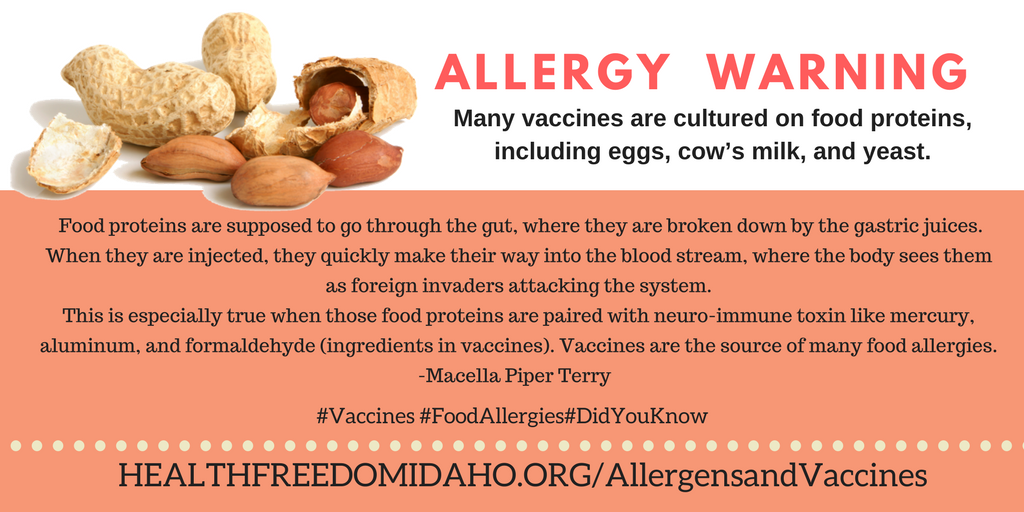
What do peanuts and vaccines have in common? Well, you’re probably thinking that some people have allergic reactions to both, and you are correct. Peanuts cause the most common severe food allergy reactions. 1.5 million children in our country are allergic to peanuts. New York Times reports “PEANUT OIL USED IN A NEW VACCINE; Product Patented for Merck Said to Extend Immunity.” For those with identified peanut allergies, this is a heart-stopping headline. However, that was 1964, and the vaccine additive was called Adjuvant 65. That excipient, though not approved in the US, became the model for subsequent vaccines. Oil in water vaccine adjuvants have always been controversial because they stimulate an abnormally strong immune response that may lead to immune disorders and yet, they are used increasingly in our vaccines. The CDC schedule has increased exponentially, the sheer number of vaccines with adjuvants that injected into the immature immune system of our children has quadrupled. Now decades later, it’s not hard to imagine where the food/peanut allergy epidemic came from. Due to the popular assumption that “vaccines are good” very little research has been conducted to see if there is a connection between the increased adjuvant laden vaccine schedule and the exponential increase in food allergens. However, a 2011 IOM report does affirm that vaccine ingredients do indeed lead to the development of allergies.15
This study was largely ignored yet the escalating increase of children with food allergens cannot be ignored. The overall economic cost of childhood food allergies was estimated to be $24.8 billion per year (remember our cost is their profit). Is the rise of allergens ONLY linked to vaccinations? ABSOLUTELY NOT! Many un-vaccinated children suffer allergies. It is just one facet of the exponential increase in toxins our children’s systems that are becoming bombarded and overwhelmed. ( Two major laboratories found an average of 200 industrial chemicals and pollutants in umbilical cord blood)
Introduction to Peanut Oil Adjuvant 65 & Highly reactive immune response adjuvants
On January 12, 1967, The New England Journal of Medicine published another report evaluating Adjuvant 65 for “human use.”3 The authors of the report, led by Robert E. Weibel, MD and Allen F. Woodhour, PhD, described Adjuvant 65 as follows:
The adjuvant preparation consisted of a water-in-peanut-oil emulsion of aqueous vaccine employing mannide mano-oleate (Arlacel A) as emulsifier and aluminum monostearate as stabilizer.3
The desirability for maximal purity of antigens included in adjuvant formulations led to the development of a highly purified aqueous influenza-virus vaccine that has been tested both as aqueous material and incorporated into adjuvant 65 with excellent results.3
The authors wrote that their report aimed to describe…
the antibody responses in children and in older persons to a highly purified bivalent influenza-virus vaccine in adjuvant 65 compared with those obtained with the purified and ordinary Sharples-concentrated aqueous vaccines. The vaccines were bivalent and contained only contemporary influenza A2 and B strains.3
According to the report, the clinical trials with Adjuvant 65-containing vaccines were performed at the Pennhurst State School and St. Joseph’s Children’s and Maternity Home in Pennsylvania. Both of those institutions cared for “mentally retarded” individuals. The “investigations” were undertaken with the “concurrence of the medical and supervisory staffs of the institutions and with the approval of the Pennsylvania Association for Retarded Children.” The participants in “Study 55” at Pennhurst were mostly adults, while those in “Study 63” were children.3
In her book The Peanut Allergy Epidemic: What’s Causing It and How to Stop It, Heather Fraser notes that Merck ultimately decided not to “pursue” Adjuvant 65 for use in vaccines licensed for use in the United States. She cites concerns about the emulsifier Arlacel A—that it “appeared to induce tumors in mice.”4

That new excipient, though not approved in the US, became the model for subsequent vaccines. ([1] p 103)
It was considered an adjuvant – a substance able to increase reactivity to the vaccine. This reinforced the Adjuvant Myth: the illusion that immune response is the same as immunity [2].
The pretense here is that the stronger the allergic response to the vaccine, the greater will be the immunity that is conferred. This fundamental error is consistent throughout vaccine literature of the past century.
According to a report by published in Clinical Microbiology Reviews by Sook-San Wong and Richard J. Webby of St. Jude Children’s Research Hospital in Memphis, TN:
Currently licensed adjuvants for vaccine usage include aluminum salt (alum) and the squalene oil-in-water emulsion systems MF59 (Novartis) and AS03 (GlaxoSmithKline). MF59 has been licensed for use with seasonal vaccines in the elderly in some countries, while ASO3 has been used in conjunction with monovalent preparations of inactivated 2009 pandemic H1N1 and prepandemic H5N1 virus vaccines.5
Oil in water vaccine adjuvants have always been controversial because they stimulate an abnormally strong immune response that may lead to immune disorders.6 Reports of squalene adjuvanted experimental anthrax vaccines were linked to autoimmune disorders in Gulf War veterans,7 although the U.S. Department of Defense continues to deny that squalene adjuvants were used in anthrax vaccines given to military personnel.
GlaxoSmithKline’s ASO3 adjuvanted H1N1 pandemic influenza vaccine used in Europe and other parts of the world in 2009-2010 have been associated with narcolepsy, an autoimmune disorder.8 9In 2013, the FDA licensed the first squalene (AS03) adjuvanted H5N1 influenza A “bird flu” vaccine for national emergency stockpiles.10 In September 2015, the FDA Vaccines and Related Biological Products Advisory Committee voted to approve fast track licensure of a squalene (MF59) adjuvanted influenza vaccine for use in the elderly, but vaccine safety advocates voiced concern about lack of adequate scientific evidence the oily adjuvant has been proven safe for use in U.S. seniors.11 12
The most commonly used adjuvant in vaccines in the United States is aluminum its neurotoxicity is has been researched and the impact is alarming.
Childhood Food Allergies on the Rise
A survey conducted by the National Center for Health Statistics highlights that prevalence of food allergies among children aged 0-17 years old increased from 3.4 percent in 1997-2011 to 5.1 percent in 2009-2011.2 Food allergies result in more than 300,000 ambulatory care visits a year among children under the age of 18.1 4 In fact, food allergies are the leading cause of anaphylaxis outside the hospital setting.1
Today almost a 1.5 million children in this country are allergic to peanuts.
Findings from a 2013 survey published in JAMA Pediatrics found that childhood food allergies result in significant direct medical costs for the U.S health care system and even larger costs for families with a child that suffers from it.3 The overall economic cost of childhood food allergies was estimated to be $24.8 billion per year. Direct medical costs amounted to $4.3 billion, costs incurred by the family totaled $20.5 billion and lost labor productivity costs totaled $0.77 billion annually.3
Our Cost is Their Profit.
According to the U.S. Food and Drug Administration, eight foods account for 90 percent of food allergic reactions: peanuts, tree nuts, eggs, wheat, soy, fish, crustacean shellfish and milk.1 4 5Research has also shown that children with food allergies are two to four times more likely to have other related conditions such as asthma than their counterparts.2
The Perfect Storm Brings A Wave of Peanut-Allergic Kinders in 1995
According to The Peanut Allergy Epidemic: What’s Causing It and How to Stop It. There were four events happened all at once leading up to 1990 so that in 1995 a wave of peanut-allergic kindergartners was sent to school for the first time.
The events of that perfect storm are:
1. Vitamin K Shot
The vitamin K1 shot became part of the general consent for treatment in hospital births in the mid-1980s. The injection was linked to leukemia in 1998, and the formula was changed in 2006. In both the new and the old versions, the popular brands of vitamin K1 contained a hefty dose of aluminum adjuvant to make a “depot” under the skin to slowly release the K1 over at least the next 2 months. The original formula contained castor oil, which is known to cross-sensitize immune systems to peanut oil. The 2006 reformulation of K1 replaced the castor oil with lecithin derived from soybean and egg. Due to the cross-reactivity molecular weights of soybean and peanut, soybean is sensitizing some babies to peanut and tree nut. That depot of aluminum is still in the infant body, churning out an IgE antibody response, at the time the baby receives the two-month vaccines. It is estimated that 4% of injected aluminum remains in the body for an indefinite period of years.
 2. Bacterial Hib Vaccine
The invention of the bacterial Hib vaccine and its subsequent licensing for use in two-month old babies arrived in 1990. Children under the age of two years were not responding to the Hib vaccine’s carbohydrate antigen, which led manufacturers to create the CDC schedule’s first “conjugate vaccine” which covalently bonded the bacterium to a toxic carrier protein that the infants’ bodies would recognize: either tetanus or diphtheria toxin. This new carrier toxin acted as an adjuvant, stimulating an immune response. Two vaccines hit the market in 1988-89 for 15 – 18-month-old babies. By 1990 the age of use had been dropped to two-month-old babies, and an additional two more vaccines were on the market, being administered at the same time as the DTP and polio vaccines. It is now known that the structure and weight of the Hib bacteria proteins are very similar to the structure and weight of the peanut protein, which leads to cross reactivity to peanuts and tree nuts. We are, essentially, creating anaphylactic babies in the same manner researchers create anaphylactic mice: administering a peanut-like protein fused to adjuvant bacterial toxin.
3. Combination Vaccines 5 in 1
By 1995 the countries of the western world were giving five vaccines in one needle for the first time. In the next three years there were 5,000 adverse reports filed in Canada, which is assumed to be only 10% of the actual adverse reactions. The effects of combining five viruses with multiple adjuvants and preservatives in one needle are essentially unstudied, though the Canadian Department of Pediatrics’ sheet on a five-in-one vaccine listed brain inflammation, convulsion, anorexia, infections, anaphylaxis, inconsolable screaming, and death as side effects.
4. Increased Vaccine Schedule Gov’t Demanded Compliance via statutes and marketing
In 1992 the already-crowded CDC vaccination schedule added additional doses of combination vaccines, resulting in load upon load of aluminum and antigens being delivered to the bodies of two-month old babies. Prior to this time the vaccination rates for children four years old and under in the western world were between 55% and 65%. The 1994 National Vaccine Plan aimed for 90% compliance for all infants and spent $500M to achieve it. Vaccinations became a requirement for preschools and daycares for the first time. Canada, Australia, and the U.K. made the same changes at the same time as the United States. Vaccination rates were suddenly at a record high — all well over 90% — on a jam-packed schedule of aluminum-loaded combination vaccines.

In the United States, emergency room records showed that from 1992-1994, 467 people per 100,000 were discharged from the ER after having experienced anaphylaxis.
By 1995 that number had almost doubled to 876 per 100,000.
By 2008 there were 1,000,000 peanut allergic children under 18 in the US and 2,000,000 adults.
We are overwhelming the immature newborn immune system with this toxic soup. It is not difficult to take Ms. Fraser’s collection of data and extrapolate the effect those reckless changes had on the similar epidemics of autism spectrum disorder, ADHD, asthma, epilepsy, childhood diabetes, and more. This country needs to take a step back and learn from the gigantic elephant in the room, even at the expense of loosening the reins of public health policy and admitting the cost that the vaccination schedule has had in collateral damage.
The most infuriating part of Ms. Fraser’s book is the light she shines into the dark corners of the “search for the cause” of the peanut allergy epidemic. She exposes the game of The Emperor Has No Clothes that has been played between pharmaceutical companies and the governments of the western world for at least the last 85 years. It is only acceptable — and, in fact, of utmost importance — to research a source of any epidemic as long as it is not vaccines, because the fact that vaccines are proven to be safe is unquestionable. Throughout her book she presents a painstakingly researched timeline and builds a convincing case of circumstantial evidence — the kind of facts that juries use to convict criminals every day of the week.
~ Robyn Charron
Research Finds Vaccinations Linked to Development of Allergens
In 2009, the U.S. Department of Health and Human Services appointed the Institute of Medicine (IOM) to provide a review of medical and scientific evidence on the adverse effects of vaccines. The 2011 IOM report does affirm that vaccine ingredients do indeed lead to the development of allergies.15 The report states:
Adverse events on our list thought to be due to IgE-mediated hypersensitivity reactions Antigens in the vaccines that the committee is charged with reviewing do not typically elicit an immediate hypersensitivity reaction (e.g., hepatitis B surface antigen, toxoids, gelatin, ovalbumin, casamino acids). However, as will be discussed in subsequent chapters, the above-mentioned antigens do occasionally induce IgE-mediated sensitization in some individuals and subsequent hypersensitivity reactions, including anaphylaxis.15
The effect of vaccine adjuvants and multiple simultaneous vaccinations also contributes to the development of food allergies. A report published in the Journal of Developing Drugs explains:
Pertussis toxin and aluminum compounds act as adjuvants. These adjuvants are known to bias for IgE synthesis. Injecting food proteins along with these adjuvants increases the immunogenicity of the food proteins that are present in the vaccines. With up to five shots administered simultaneously, numerous food proteins and adjuvants get injected at one time. This increases the probability of sensitization.12
The 2011 IOM report does affirm that vaccine ingredients do indeed lead to the development of allergies.15 The report states:
Adverse events on our list thought to be due to IgE-mediated hypersensitivity reactions Antigens in the vaccines that the committee is charged with reviewing do not typically elicit an immediate hypersensitivity reaction (e.g., hepatitis B surface antigen, toxoids, gelatin, ovalbumin, casamino acids). However, as will be discussed in subsequent chapters, the above-mentioned antigens do occasionally induce IgE-mediated sensitization in some individuals and subsequent hypersensitivity reactions, including anaphylaxis.15
These findings are now almost a decade old. Current research and discussion on the cause of food allergies has not addressed the effects of vaccines. This is an important area of research to pursue, given that the number of vaccines recommended in the CDC’s childhood vaccine schedule has doubled since 1983.

The popular assumption that “vaccines are good” is more than likely the reason why vaccination is not considered to be a factor when examining in the cause of food allergies. It is crucial for public health agencies and officials to explore this angle and focus efforts on understanding the impact of vaccination on the development of childhood food allergies among other health conditions before it’s too late.
- RESOURCES:
- https://vactruth.com/2010/07/15/non-disclosed-hyper-allergenic-vaccine-adjuvant/
- Are Peanut Adjuvants in Vaccines Responsible for the Peanut Allergy Epidemic?
- http://thinkingmomsrevolution.com/whats-really-behind-peanut-allergy-epidemic/
- NEW YORK TIME ARTICLE INFORMATION:
The vaccine was developed by Allen F. Woodhour, PhD and Dr. Thomas B. Stim over the course of six years as part of a partnership between the Merck Institute for Therapeutic Research and the Children’s Hospital of Philadelphia, PA.1 According to the Times article, the vaccine was still under study at the time and had not been licensed for “general use,” although clinical trials had been conducted on 880 individuals, who had been given the killed influenza virus containing Adjuvant 65.1 A report published in The New England Journal of Medicine on September 3, 1964 described the “clinical and immunologic findings” of the trials on the participants, which resulted in the “development of a new and highly effective adjuvant, called adjuvant 65.”2
- ([1] p 103) 1. Fraser, H, The Peanut allergy epidemic, Skyhorse 2011
- 2. O’Shea, T, Vaccination is not immunization, thedoctorwithin 2013
- 9. Technical Report # 595, Immunological Adjuvants, World Health Org. 1976.