Tag: glyphosate

  • Dirty Dairy Ben and Jerry’s

    The Vermont brand has been built on a bucolic image of cows grazing on endless pastures . . . Ben & Jerry’s ice cream and other Vermont companies have used this idyllic imagery to sell their products. Gone are the days, however, when most of Vermont’s cows were grazing in spectacularly scenic landscapes. Now a majority of Vermont’s cows are locked up in . . . ‘confined animal feeding operations’ or CAFOs . . . grazing on concrete with a diet rich in GMO corn and pesticides. – “Vermont’s GMO Addiction: Pesticides, Polluted Water and Climate Destruction,” Regeneration Vermont

    The most important thing we can do today as conscious consumers, farmers and food workers is to regenerate public health, the environment and climate stability. We can do this most readily by moving away from industrial, GMO and factory-farm food toward an organic, pasture-based, soil-regenerative, humane, carbon-sequestering and climate-friendly agriculture system.

    What’s standing in the way of this life-or-death transformation? Rampant greenwashing. The proliferation of $90 billion worth of fraudulently labeled or advertised “natural” and “socially responsible” food products in the U.S. confuses even the most well-intentioned of consumers and lures them away from purchasing genuine organic or grass-fed products.

    Perhaps no company personifies greenwashing more than Vermont-based Ben & Jerry’s.  Ben & Jerry’s history—a start-up launched by two affable hippies, from a renovated gas station in Burlington, Vt., —is legendary. Despite selling out to Unilever in April 2000, the brand’s handlers have preserved its quirky, homespun image, and masterfully convinced consumers that Ben & Jerry’s has never strayed from its mission: “to make the world a better place.”

    As the New York Times reports, the Organic Consumers Association (OCA) recently sent samples of Ben and Jerry’s top-selling ice cream brands to an independent testing lab for analysis. Ten out of 11 samples tested positive for Roundup (glyphosate and AMPA) herbicide contamination

    So much for making the world a better place.

    Compare the Ben & Jerry’s test results with the results of our testing of organic brands, brands that use organic milk from farms that are actually making the world a better place. Three out of four nationally distributed organic ice cream brands tested negative for Roundup contamination (only Whole Foods “365” brand was contaminated).

    A history of stalling on organic

    Twenty-four years ago, anti-GMO food activists, including the Pure Food Campaign (OCA’s predecessor), successfully pressured Ben & Jerry’s and a number of other leading dairies to prohibit the use of America’s first genetically engineered food product, Monsanto’s recombinant Bovine Growth Hormone (rBGH). Now marketed by drug giant Elanco (Eli Lilly), rBGH is linked to increased risk of human breast and colon cancer, a greater use of antibiotics in animal feed, and damage to cow’s health.

    Several groups, including the OCA, subsequently asked Ben & Jerry’s to move beyond just prohibiting their dairy cows from being injected with rBGH. We asked them to go 100 percent organic, which would have required the company to ban its dairy suppliers from feeding their cows GMO corn and grain, and to use only organic ingredients in its flavors. But even before Ben & Jerry’s was bought out by Unilever, company founder Ben Cohen told Vermont Food activist Michael Colby “that Ben & Jerry’s was not going to transition to organic because it wouldn’t allow them to ‘maximize profits.’ “ 

    Since 1994, Ben & Jerry’s, the $1.5-billion-per-year flagship brand of the second-largest multinational food corporation in the world, Unilever (annual sales $60 billion), has cashed in big time on its “rBGH-free” policy, advertising its brand, over and over again, as “all natural,” “GMO-free,” “fair trade,” “climate-just,” and “socially responsible.”

    Despite repeated calls from consumer groups to stop advertising its ice-cream as “natural” or “all natural,” given that it is derived from cows raised almost exclusively on GMO corn forage (grown with Roundup Ready, neonic-, and BT-spliced seeds), laced with non-organic ingredients, sprayed heavily with Roundup and other pesticides, Ben & Jerry’s continues to greenwash and lie. The company recently (June 18, 2017) described its mission as:

    To make, distribute and sell the finest quality and euphoric concoctions with a continued commitment to incorporating wholesome, ingredients and promoting business practices that respect the Earth and the Environment.

    After more than a decade of dodging consumer, farmer, animal welfare, environmental and farmworker pleas to stop greenwashing and to equitably source its milk from cows grazing on organic pasture, Ben & Jerry’s continues to stall. Instead, Ben & Jerry’s sources its milk from St. Alban’s, a 400-farmer dairy co-op that is increasingly dominated by large factory farm-type dairy operations. To feed their cows, farmers routinely spray tons of pesticides, including Roundup, atrazine and metolachlor, on fields of GMO corn grown from neonic-coated and BT toxin seeds. They also apply tons of soil-killing, climate-disrupting nitrogen fertilizers that pollute Vermont’s streams, rivers and lakes.

    Petitions and protests calling for Ben & Jerry’s to stop its suppliers from exploiting farmworkers, confining dairy cows and driving small dairy farmers into bankruptcy, have produced nothing more than vague promises of “respecting the Earth” and supporting rural economic justice.

    Enough is enough. Vermont and national public interest organizations have lost our patience. It’s time for Unilever and Ben & Jerry’s to move beyond greenwashing to decisive action. It’s time for Ben & Jerry’s to announce it will immediately begin transitioning to 100-percent organic. Otherwise conscious consumers have no choice but to launch a national and, if necessary, international protest campaign and boycott.

    Vermont activists demand major changes from Ben and Jerry’s

    Regeneration Vermont, a broad-based coalition of consumers and farmers, has repeatedly asked Ben & Jerry’s and Unilever to sign a six-point pledge to go 100-percent organic over a three-year transition period. Here’s what the groups want Ben & Jerry’s to pledge:

    1. A transition away from GMO crops and toxic pesticides/fertilizers and toward regenerative organic agricultural methods.
    2. Fair wages for farmers, including premiums based on regeneration benchmarks and assistance in the transition toward regenerative methods.
    3. Economic justice for farm workers, fair and livable wages, decent housing and social and cultural dignity.
    4. Adoption of climate remediation techniques, beginning with an emphasis on healthy soils and cover-cropping for carbon sequestration and erosion control.
    5. Humane treatment of farm animals, a phase-out of confinement dairies and a transition back to grassland grazing and grass-based feed for ruminants.
    6. Cleaning up and protecting our watersheds, streams, rivers, ponds, lakes, and groundwater.

    A trail of toxins

    Recent reports published by Regeneration Vermont reveal that Ben & Jerry’s suppliers, and Vermont and U.S. (non-organic) dairy farmers in general, have gone backward, rather than forward over the past 15 years in terms of environmental sustainability, food safety, nutrition, greenhouse gas pollution, water pollution, animal welfare, farmworker justice, and preservation of family farms.

    Chemical fertilizer use has also almost doubled in Vermont since GMOs began to dominate the market 15 years ago. 

    So much for Monsanto’s claims that GMO crops would reduce the use of toxic pesticides and water- polluting and climate-destabilizing nitrogen fertilizers. Not to mention Ben & Jerry’s claim that it is “non-GMO” and “environmentally responsible.”

    Among Regeneration Vermont’s finding are the following:

    • An astounding 97 percent of Vermont’s field corn, the major component of a non-organic dairy cow’s diet, is now GMO (Roundup Ready, Bt-spliced, neonic seeds). This is the highest percentage of any state in the U.S.

    • Herbicide use has increased over 100 percent-per-acre in Vermont since Monsanto’s GMO corn came on the market, with recent heavy use of atrazine, metholachlor, simazine, pendimethlin, glyphosate (Roundup), acetochlor, dicamba, and alachlor.

    As Regeneration Vermont states in its report:

    Regulators have determined that five of these eight most used herbicides [in Vermont] are possible or probable human carcinogens, the remaining three are suspected carcinogens. Seven of the eight are possible or probable endocrine disruptors (the other one is a suspected to be an endocrine disruptor). All eight have been determined by regulators and academics to cause birth or developmental defects and contaminate drinking water and public waters with dangerous chemicals that have long-term persistence. Atrazine, simazine, acetachlor, and alachlor have lost their registration in the EU, and are effectively banned.

    The threat of #DirtyDairy and factory farms

    Millions of health-minded Americans, especially parents of young children, now understand that cheap, non-organic, genetically engineered, industrial and factory farm food is hazardous. Not only does chemical- and energy-intensive factory farming destroy the environment, destabilize the climate, impoverish rural communities, exploit farm workers, inflict unnecessary cruelty on farm animals, and contaminate the water supply, but the end product itself is inevitably contaminated and inferior in nutritional terms, in this case in comparison to 100% grass-fed and organic milk and dairy.

    America’s green-minded consumers understand that industrial agriculture poses a terminal threat to the environment and climate stability. A highly conscious and passionate segment of the population is beginning to understand that converting to non-chemical, non-genetically engineered, energy-efficient, carbon-sequestering organic/regenerative farming practices, and drastically reducing food miles by re-localizing the food chain, are essential preconditions for stabilizing our out-of-control climate and preparing our families and communities for future energy and resource shortages.

    A critical mass of the global grassroots—consumers, farmers, activists—now realize that unless we act quickly, global warming and climate chaos will soon severely disrupt industrial agriculture and long-distance food transportation, leading to massive crop failures, food shortages, famine, war, and pestilence. Even more alarming, accelerating levels of greenhouse gases will soon push global warming to a tipping point that will melt the polar icecaps and possibly unleash a cataclysmic discharge of climate-destabilizing methane, now sequestered in the fragile arctic tundra.

    Thanks to this growing consumer awareness—and four decades of hard work—the organic community has built up a $50-billion “certified organic” and $5-billion 100% grass-fed food and products sector that prohibits the use of genetic engineering and pesticides. The rapidly expanding organic products sector now constitutes more than 5 percent of total retail grocery sales (and 15 percent of fruits and vegetables), with an annual growth rate of 10-15 percent.  Even taking into account a sluggish economy, the organic market, if we eliminate greenwashing and labeling fraud, could conceivably reach a “tipping point” of 20 percent of grocery sales in 2020.

    The myth of “natural” remains a threat

    As impressive as this $55 billion Organic and Grass-fed Alternative is, it remains overshadowed by an additional $90 billion in annual spending by consumers on products, such as B&J’s, fraudulently marketed as “natural,” “gmo-free,” “free range,” or “sustainable.”

    Consumer surveys indicate that the overwhelming majority of Americans believe that “natural” products are “almost organic,” yet at the same time, much cheaper; the majority believes that “all natural” actually means that it is better than organics. Ben & Jerry’s is not the only brand greenwashing its products and impeding the growth of organic, 100% grass-fed and regenerative foods. But it is certainly among the most shameless.

    In fact, all these “natural,” “all-natural” and “sustainable” products are neither backed up by rules and regulations, nor a third-party certifier. Most “natural” or conventional products—whether produce, dairy or canned or frozen goods—are produced on large industrial farms or in processing plants that are highly polluting, chemical-intensive and energy-intensive.  

    Perhaps fraudulently labeled “natural” foods such as Ben & Jerry’s wouldn’t matter so much if we were living in normal times, with a relatively healthy population, environment and climate. Conventional products sold as “natural” or “nearly organic” would be just one more example of chicanery or unethical business practices.

    But we are not living in normal times.

    Demanding that fake natural brands and producers, such as Ben & Jerry’s, make the transition to organic is a matter of life or death. We’re tired of pleading and politely asking Ben & Jerry’s, Unilever and other greenwashers to please change their ways. It’s time to step up the pressure. Please join the growing boycott of Ben & Jerry’s ice-cream by signing this petition and by volunteering to join a local campaign team in your local community.

    Ronnie Cummins is international director of the Organic Consumers Association.

    This article originally appeared at: https://www.organicconsumers.org/essays/dirty-dairy-why-consumers-need-force-ben-and-jerrys-go-organic.
  • Ban Lifted For Sale of Natural Alternative To Toxic Round Up

    HFI:  North End Organic Nursery Boise, Idaho shared through social media, that Horticultural vinegar is a highly effective product to reduce/eliminate weeds that DOES NOT CONTAIN CANCER CAUSING GLYPHOSATE. That’s when the State decided they were not allowed to sell the natural alternative product. Within days, hundred of customers and citizens alike expressed outrage at the over step of power of the ISDA. An agreement was made, and the product will return to the stores, without the label that it can be used effectively against weeds. Moral of the story…the state is watching (yes, even social media) and they are listening, to our posts, our calls and our emails. Perhaps we should begin a dialogue to REDUCE the usage of glyphosate in our public spaces!

    July 14, 2017

    North End Organic Nursery Boise
    owner Lindsay Schramm, was SHOCKED with Kevin Kostka, an enforcement officer for State of Idaho, told her that a product known as horticultural vinegar — effective as a non-toxic alternative for battling weeds – could not be sold her her stores.

    This product, sold in her store for years, has been effective as an alternative to carcinogenic weed killers containing glyphosate – such as Roundup. The State realized its effectiveness in reducing weeds, after a popular time-lapse video was shared from youtube and facebook.

    Schramm shared on facebook, “This is food grade Horticultural vinegar, and just like salt, has many different uses, and we believe they are out of their jurisdiction and scope of power to tell us that we are not allowed to sell it.


    “Somebody at some point stumbled across the fact that, hey, if you put it full strength on a weed, the weed dies,” Schramm said. “With all of the terrible things that are out there right now, people got excited about the possibility of using something that’s very simple, nontoxic product.

    “It may not have been originally intended as an herbicide, but it just so happens to work great as an herbicide.” 


    HEALTH FREEDOM IDAHO ASKS: Is the State banning and limiting the sales of probably carcinogenic products containing glyphosate? 

    THE WIN!!!
    July 17 5:30 PM North End Organic Nursery Posted An Update: “we are desiring to work with the ISDA, not against them, and after some civil conversations we are working on a resolution. Thank you all for your support. Nothing has changed yet, but we are optimistic.”

    On Tuesday July 18, North End Nursery posted that they fround a place of agreement: Scramm will relabel the bottles, removing reference to use of horticultural vinegar as an herbicide, and then the department will allow the store to resume selling the vinegar.

    Soon you will be able to purchase your horticultural vinegar AGAIN from North End Organic Nursery. 

  • Round Up Toxicity: It’s NOT just the carcinogen glyphosate

    Monsanto’s Roundup is more toxic than what the majority believe

    More and more studies are revealing compelling evidence on the toxicity of Monsanto’s best selling weed-killer Roundup. In 2004, a study published in the Journal of Pesticide Reform, showed toxicity of “glyphosate” (active ingredient in Roundup) and how it’s designed to deprive plants from essential nutrients, kill useful insects and microorganisms and pollute the earth.

    However, as toxic as glyphosate is, the only problem with Roundup isn’t only glyphosate but the fact that Roundup has many other “insert” ingredients that are not properly labeled. Studies show that these insert ingredients increase the toxicity and harmful side effects of glyphosate.

    In a study published in the journal Chemical Research in Toxicology, the researchers tested Roundup on human’s cells and they found that one of the “insert” ingredients used as surfactant in Roundup called “polyethoxylated tallowamine, or POEA”, can significantly increase the toxic effect of “glyphosate”.

    There are also other toxic chemical compounds used in Roundup such as “5-Chloro-2-methyl 3(2H)-isothiazolone and 3-Iodo-2-propynyl butyl carbamate” and they are all linked to many health issues including infertility, allergies, genetic damage, cancer and thyroid problems. Check at the list of insert ingredients in glyphosate herbicide products.

    While governmental regulatory like Environmental Protection Agency (EPA) and FDA consider Roundup safe, independent scientists that are not funded by biotech companies like Monsanto suggest that Roundup is toxic to human’s health – including governments of nearly 50 other countries:

    According to rodale.com, in U.S. alone, homeowners and farmers use about 100 million pounds of Roundup herbicide every year. At the same time, weeds are becoming more resistant to Roundup, so farmers are using more and more chemicals to deal with super-pests and super-weeds. From 1994 to 2005, the use of glyphosate has increased by 1,500 percent.

    However, in 2009, an environmental group in Argentina filed a petition for banning glyphosate, after a study linked glyphosate to neurological problems and nervous system disorder. Also, the government of Argentina funded a research and discovered that the cancer rate was higher in areas that people used glyphosate. Also, many independent laboratory studies have linked glyphosate to genetic damage and recent studies have linked glyphosate exposure to a type of blood cancer known as lymphoma.

    According to foodandwaterwatch.org, a recent study shows how glyphosate damages the cytochrome P450 (CYP) gene pathway and creates enzymes that help to form and breakdown molecules in cells. Cytochrome P450 (CYP) gene pathway are essential for normal functioning of different organs in our bodies and even small changes in its expansion can lead to variety of health problems and complications.

    For example, exposure to glyphosate in humans can significantly lower the level of essential amino acids that’s necessary for neurotransmitter serotonin. Low serotonin levels are linked to depression, Alzheimer’s and obesity. All these side effects can work together and trigger other health problems including gastrointestinal problems, cardiovascular disease, autism and diabetes.

    Monsanto and its financial beneficiaries who discredit actual scientific studies about GMOs and call these studies “bad science” or “another bogus study” are just bunch of “opportunists” that are allergic to facts: 

    Monsanto and its thugs should know that “the cat is out of the bag” and there is no more hiding or pretending. We know that the majority of researches that claim safety of glyphosate are performed by scientists who are funded by Monsanto.

    Monsanto and its financial beneficiaries should be ashamed of themselves for blocking the rights of ordinary Americas to know what they are eating. If these crowds had some honor, they would jump off of a tall building instead of poisoning our nation with glyphosate residue found in soy, sugar, corn or wheat.

    Recently, the House of Representatives that are true representative of biotech companies like Monsanto voted against GMO labeling bill. Apparently, these so called “elected officials” do not believe in the right of every citizen in this country to know what they are eating, however, they apparently believe in the right of biotech companies to poison us. Click here to see who these so called representatives are.

    Sources:

    http://www.pesticide.org/get-the-facts/pesticide-factsheets/factsheets/glyphosate

    http://www.foodandwaterwatch.org/blogs/new-review-points-to-glyphosates-dangerous-health-effects/

    http://www.mdpi.com/1099-4300/15/4/1416

    http://www.rodale.com/roundup-weed-killer-more-toxic-originally-believed#.UeBxgtAosVA.twitter

    Related Articles:

    http://www.seattleorganicrestaurants.com/vegan-whole-food/Monsanto-pest-weed-resistant-crops.php

    http://www.seattleorganicrestaurants.com/vegan-whole-foods/monsantos-roundup-glyphosate/


  • Nampa ID City Parks Reduce Usage of Health Damaging Roundup

    HFI: VERY important news…

    “Napa is phasing out the herbicide, known by its brand name Roundup, and is substituting other substances, plus increased mulching to attack weeds in public recreational areas, according to Dave Perazzo, the city’s director of parks, trees and facilities.”
    See Full Article At the Nampa Registar http://napavalleyregister.com/news/local/napa-edges-away-from-glyphosate-weed-killer-in-city-parks/article_096c09bd-140e-5a3d-a325-d97cab4e88e2.html

    Why This Is Important

    Used in yards, farms and parks throughout the world, Roundup has long been a top-selling weed killer. But now researchers have found that one of Roundup’s inert ingredients can kill human cells, particularly embryonic, placental and umbilical cord cells.

    The new findings intensify a debate about so-called “inerts” — the solvents, preservatives, surfactants and other substances that manufacturers add to pesticides. Nearly 4,000 inert ingredients are approved for use by the U.S. Environmental Protection Agency.

    Glyphosate, Roundup’s active ingredient, is the most widely used herbicide in the United States.  About 100 million pounds are applied to U.S. farms and lawns every year, according to the EPA.

    Until now, most health studies have focused on the safety of glyphosate, rather than the mixture of ingredients found in Roundup. But in the new study, scientists found that Roundup’s inert ingredients amplified the toxic effect on human cells—even at concentrations much more diluted than those used on farms and lawns.

    One specific inert ingredient, polyethoxylated tallowamine, or POEA, was more deadly to human embryonic, placental and umbilical cord cells than the herbicide itself – a finding the researchers call “astonishing.”

    “This clearly confirms that the [inert ingredients] in Roundup formulations are not inert,” wrote the study authors from France’s University of Caen. “Moreover, the proprietary mixtures available on the market could cause cell damage and even death [at the] residual levels” found on Roundup-treated crops, such as soybeans, alfalfa and corn, or lawns and gardens.

    The research team suspects that Roundup might cause pregnancy problems by interfering with hormone production, possibly leading to abnormal fetal development, low birth weights or miscarriages.

    “The authorizations for using these Roundup herbicides must now clearly be revised since their toxic effects depend on, and are multiplied by, other compounds used in the mixtures,” Seralini’s team wrote.

    Controversy about the safety of the weed killer recently erupted in Argentina, one of the world’s largest exporters of soy.

    Last month, an environmental group petitioned Argentina’s Supreme Court, seeking a temporary ban on glyphosate use after an Argentine scientist and local activists reported a high incidence of birth defects and cancers in people living near crop-spraying areas. Scientists there also linked genetic malformations in amphibians to glysophate. In addition, last year in Sweden, a scientific team found that exposure is a risk factor for people developing non-Hodgkin lymphoma.

    Inert ingredients are often less scrutinized than active pest-killing ingredients. Since specific herbicide formulations are protected as trade secrets, manufacturers aren’t required to publicly disclose them. Although Monsanto is the largest manufacturer of glyphosate-based herbicides, several other manufacturers sell similar herbicides with different inert ingredients.

    The term “inert ingredient” is often misleading, according to Caroline Cox, research director of the Center for Environmental Health, an Oakland-based environmental organization. Federal law classifies all pesticide ingredients that don’t harm pests as “inert,” she said. Inert compounds, therefore, aren’t necessarily biologically or toxicologically harmless – they simply don’t kill insects or weeds.

    Kemery said the EPA takes into account the inert ingredients and how the product is used, whenever a pesticide is approved for use. The aim, he said, is to ensure that “if the product is used according to labeled directions, both people’s health and the environment will not be harmed.” One label requirement for Roundup is that it should not be used in or near freshwater to protect amphibians and other wildlife.

    But some inert ingredients have been found to potentially affect human health. Many amplify the effects of active ingredients by helping them penetrate clothing, protective equipment and cell membranes, or by increasing their toxicity. For example, a Croatian team recently found that an herbicide formulation containing atrazine caused DNA damage, which can lead to cancer, while atrazine alone did not.

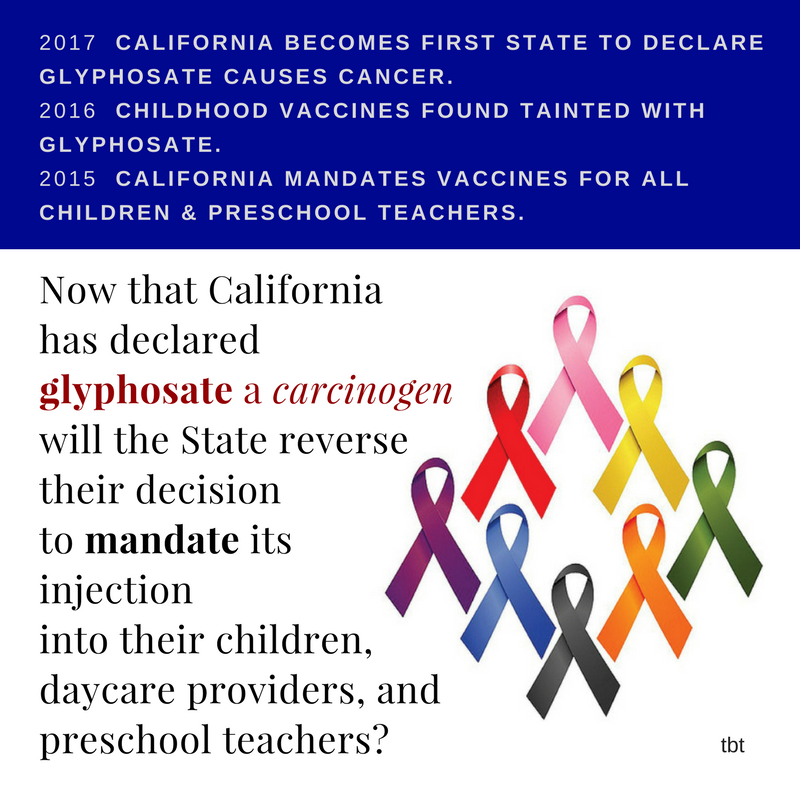
  • CA Mandates Glyphosate Tainted Vaccines For All Kids Then Admits Glyphosate Causes Cancer.

    HFI: Roundup contains Glyphosate a chemical that CA is now labeling as a known cancer causing toxin. In 2015, CA mandated the injection of glyphosate tainted vaccines into all the children of the state as well as the preschool teachers and daycare providers. (Sb277.org)  
    It is CRITICAL that we eliminate the political stranglehold the pharmacutical companies have over our politicians. They are immune from liablity while pushing their multi-billion dollar product (proven to contain cancer-causing toxins) into our children, teachers and medical staff. 

    California Mandates Childhood Vaccines for its children

    Highly contested, California decided to mandate vaccines for all its children entering daycare, preschools or school settings. Effective July 2016, the bill SB277 was designed by lobbist of the pharamicutical companies and sponsed by Senator Richard Pan. While the state already had vaccines rates exceeding 95% the State was driven by the fear of measles. An “outbreak” happening at Disneyland.

    • NOT A SINGLE INDIVIDUAL DIED from the disease. 
    • The majority of the individuals 85%+ were vaccinated, more than half were adults.
    •  Not a SINGLE CASE TRANSMITTED through schools or daycares.

       ECO WATCH Reported Sept 10, 2016:

      Glyphosate Found in Childhood Vaccines

      By Zen Honeycutt

      Glyphosate, the active ingredient in Monsanto’s flagship herbicide Roundup and hundreds of other herbicides, has been found in vaccines. Moms Across America received preliminary screening results from Microbe Inotech Laboratories Inc. of St. Louis, Missouri, which showed:

      • MMR II (Merk) vaccine had 2.671 parts per billion (ppb) of glyphosate
      • DTap Adacel (Sanofi Pasteur) vaccine had 0.123 ppb of glyphosate
      • Influenza Fluvirin (Novaris) 0.331 ppb of glyphosate
      • HepB Energix-B (Glaxo Smith Kline) 0.325 ppb of glyphosate
      • Pneumonoccal Vax Polyvalent Pneumovax 23 (Merk) had 0.107 ppb of glyphosate

      The MMR II vaccine had levels up to 25 times higher than the other vaccines. Following our test, additional independent tests have confirmed these findings at or above the same levels. The tests were conducted using the ELISA method.

      http://www.ecowatch.com/glyphosate-vaccines-1999343362.html

      ECO WATCH Reported March 30, 2017:

      California Becomes First State to Declare Glyphosate Causes Cancer

      The state of California has finalized its decision designating glyphosate, the main ingredient in the pesticide Roundup, as a known human carcinogen under the state’s Proposition 65. The listing was prompted by the World Health Organization’s finding that glyphosate is a “probable” human carcinogen. The World Health Organization’s cancer research agency is widely considered to be the gold standard for research on cancer.

      When it comes to Roundup, California has become a national leader in flagging the very real danger posed by this vastly over-used pesticide,” said Nathan Donley, a senior scientist at the Center for Biological Diversity and a former cancer researcher. “The state based its decision on the findings of the world’s most reliable, transparent and science-based assessment of glyphosate.”

      Glyphosate is the most widely used pesticide in the U.S. and the world. It is also the most widely used pesticide in California, as measured by area of treated land. An analysis by the Center for Biological Diversity found that more than half of the glyphosate sprayed in California is applied in the state’s eight most-impoverished counties. The analysis also found that the populations in these counties are predominantly Hispanic or Latino, indicating that glyphosate use in California is distributed unequally along both socioeconomic and racial lines.

      “It’s become painfully clear that we can no longer ignore the risk that this pesticide poses to people and wildlife,” Donley said.

      Earlier this month, a report released by a key scientific advisory panel concluded that the pesticides office at the U.S. Environmental Protection Agency (EPA) failed to follow its own guidelines when it found last year that glyphosate—the active ingredient in Monsanto’s flagship pesticide Roundup—is not likely to be carcinogenic to humans.

      And court documents released last week revealed that the chair of the EPA’s Cancer Assessment Review Committee on glyphosate was in regular contact with Monsanto, providing insider information that guided Monsanto’s messaging. The chair promised to thwart the Department of Health and Human Services’ review of glyphosate’s safety, saying that if he was successful he deserved a medal. The department never did review glyphosate’s safety.

  • The Most Toxic Chemical Ever Used Now Found In Our Natural Suppliments?

    The Most Toxic Chemical Ever Used Now Found In Our Natural Suppliments?

    HFI: Glyphosate. Its that chemical found in roundup, that is sprayed on our fields, on our foods and eaten by the animals we eat. The cycle of contamination continues as it ends up in the gelatin that is used in capsules packaging supplements and medicines. 

    From the Healthy traditions website:

    Glyphosate is in 80% of our food supply in the U.S., and may well be the most toxic chemical ever approved for commercial use, according to some scientists. Scientists now link glyphosate to kidney disease, antibiotic resistant bacteria, inflammatory bowel disease, obesity, depression, ADHD, autism, Alzheimer’s disease, Parkinson’s disease, ALS, multiple sclerosis, cancer, cachexia, infertility, and developmental malformations. It reportedly destroys the microbiome of humans and plants, which is seen by some as the root cause of many modern diseases.

    To learn more about the dangers of glyphosate, see:

    Glyphosate Herbicide Causes Antibiotic Resistant Bacteria, Kidney Disease, and Infertility

    Is Glyphosate Responsible for your Health Problems?

    Common Weedkiller Used in Modern Agriculture Could be Main Factor in Gluten Intolerance

    MIT Researcher: Glyphosate Herbicide will Cause Half of All Children to Have Autism by 2025

    From the Green Pastures.Org Blog:

    Once you think of glyphosate insinuating itself into collagen, it’s an easy step to imagine that glyphosate would be a major contaminant in gelatin, a very common food additive and the main constituent of gelatin-based deserts. Gelatin is routinely added to marshmallows, pudding, gummy bears, yogurts, margarine, frosting, cream cheese, sour cream, non-dairy creamers and fat-reduced foods.

    There are hundreds if not thousands of proteins that strongly depend on glycine at certain spots in their chain in order to adequately perform their job.

    Gelatin is typically derived from the bones, joints and skin of pigs and cows. These animals are fed high doses of glyphosate in their GMO Roundup Ready corn and soy feed. The glyphosate that makes its way into their joints ends up in your gelatin dessert.

    Gelatin is also the main constituent of gel caps, which have become a standard way of packaging both pharmaceutical drugs and nutritional supplements such as fish oil. I would predict that any nutritional supplement housed in a gel capsule is going to cause you much more harm than good, because whatever benefit the contents provides is more than offset by the damaging effects of the glyphosate.

    Please read the rest of the article to read about the full impact of glyphosate.

  • Action Alert: Tell the EPA “NO” more 2,4-D and glyphosate

    Action Alert: Tell the EPA “NO” more 2,4-D and glyphosate

    ACTION ALERT! Add your name to the petition here. 
    Excerpt of the proposal from the Center for Food Safety: 

    The EPA is proposing a dramatic expansion of the use of the toxic pesticide Enlist Duo. Enlist Duo is a mixture of glyphosate (the active ingredient in Monsanto’s Roundup®) and the even more toxic 2,4-D (part of the chemical mixture Agent Orange). If approved the pesticide cocktail could be used on corn, soy, and cotton in 34 states — up from 15 states where the product was previously approved for just corn and soy.

    The rush to expand the use of Dow AgroSciences’ toxic chemical concoction of glyphosate and 2,4-D for use on the next generation of genetically engineered crops comes only one year after the EPA asked a court to revoke its previous approval due to the unknown risks it posed, and now EPA suddenly wants to more than double the number of states where the pesticide can be used.

    Major news outlets are saying these crops are a serious cause for concern. According to the Los Angeles Times: “Just as the nation must stop overusing antibiotics if it hopes to slow the emergence of resistant infections, it must do the same with herbicides and genetically modified crops. The way to deal with so-called superweeds isn’t by escalating the arms race against them.”

    This GE crop system ensures a toxic spiral of ever-increasing chemical use on our land and food and poses a grave threat to our health. 2,4-D has been linked to major health problems including cancer, Parkinson’s disease, endocrine disruption, and reproductive problems. This approval would trigger millions of more pounds of toxic herbicides dumped onto our land. Even USDA admitted it could be as much as 176 million pounds per year!

    Tell the EPA to reject this massive expansion in the use of Enlist Duo!

  • Weed killer found contaminating most popular US foods

    Weed killer found contaminating most popular US foods

    Picture

    FIND OUT WHAT’S IN YOUR FOOD!
    http://www.cornucopia.org/

    The old saying ‘you are what you eat’ is so true.
    The chemicals that are put on our food are ‘considered safe’ because they are so minute. However, they are cumulative and since most are not properly tested prior to release, we are seeing an unbelievable rise ailments. These chemicals have had time to build up also instead of dissipate like we were told they would once they were applied.
    For the last 20 years, these chemicals have had the chance to deplete our soils from so many nutrients. Our food is void of what we thought we were eating.
    NOVEMBER 2016

    Glyphosate is the world’s most widely used herbicide in agriculture and gardening. Several global scientific agencies have found the chemical is unlikely to cause cancer in people exposed to it through food. 

    Food Democracy Now!, a non-governmental organization, enlisted Anresco Laboratories to carry out the study. The food safety testing lab is registered with the U.S. Food and Drug Administration.

    Glyphosate food testing results, in parts per billion (ppb).

    Glyphosate food testing results, in parts per billion (ppb).

    IMAGE: FOOD DEMOCRACY NOW!

    Researchers found original Cheerios had the highest level of glyphosate compared to other foods tested, at about 1,123.5 parts per billion — or 1.125 milligrams of glyphosate per 1 kilogram of cereal. 

    On their own, those numbers seem meaningless. Who will realistically eat that much cereal in 24 hours, and do so day after day?

    However, since most people regularly eat a range of cereals and snack foods, their total exposure to glyphosate may be higher than results for a single item suggest. And the less you weigh, the more glyphosate you consume relative to your body weight, so toddlers munching on Cheerios have much higher exposure. 

    Monsanto’s glyphosate propaganda – a line which is parroted by the Monsanto-influenced FDA – holds that the substance poses no threat to humans and affects only plants.
    From Natural Health 365:
    “Scientists for Monsanto – the most hated corporation in the world – insist that glyphosate is safe because it targets a metabolic system called the shikamate pathway – which humans and animals lack. Yet the trillions of beneficial bacteria in the human digestive tract do have this pathway – and disrupting it can have catastrophic consequences.
    “In truth: Glyphosate harms critical beneficial bacteria, causing an overgrowth of pathogens, which in turn produce toxic phenols that cause inflammation … .”

    Glyphosate: a ‘wrecking ball’ to the human body

    Dr. Stephanie Seneff, an MIT senior research scientist and environmental toxins expert, is known for having documented the link between glyphosate and autism. She also believes that glyphosate is responsible for many other chronic diseases whose rates have soared in recent years, since the introduction of glyphosate. Dr. Seneff labels glyphosate as “the most significant chemical used today,” and one that has the effect of a “wrecking ball” on the human body.
    From Pompa:
    “Glyphosate is what Dr. Seneff calls a ‘monster molecule,’ and affects human biology in many ways. …
    “Dr. Seneff believes that glyphosate exposure is catapulting gluten sensitivity into epidemic proportions.”
    Aside from its effects on the gut, glyphosate has been linked to liver, kidney, pancreatic, thyroid and colon cancer – as well as ADHD, Alzheimer’s, birth defects, brain cancer, breast cancer, diabetes, heart disease, obesity, Parkinson’s, multiple sclerosis and more.
    Meanwhile, the EPA – another agency bribed into doing Monsanto’s bidding – continues to quietly raise the acceptable levels of glyphosate in our food supply. Fifty times the amount of glyphosate is now allowed on corn than was permitted in 1996, for example, and the total allowed amount has increased by a factor of 17.

    It’s time to get Monsanto’s Roundup off your plate, ban glyphosate and label GMOs! We need your help today. Every voice counts! The report can be viewed here.