
Tag: labeling

  • Talking Turkey: Conventional vs Organic

    When you choose your next turkey, what factors will you take into consideration? Do you want more meat or would you rather preserve an endangered breed? Do you know, understand the marketing gimmicks used by the industry to make you pay more? Organic turkeys are often in high demand; so if you choose to get one, you should order it now (if you haven’t already). Whole Foods/Amazon has a sale through November 26. <Click here >
    Hormones

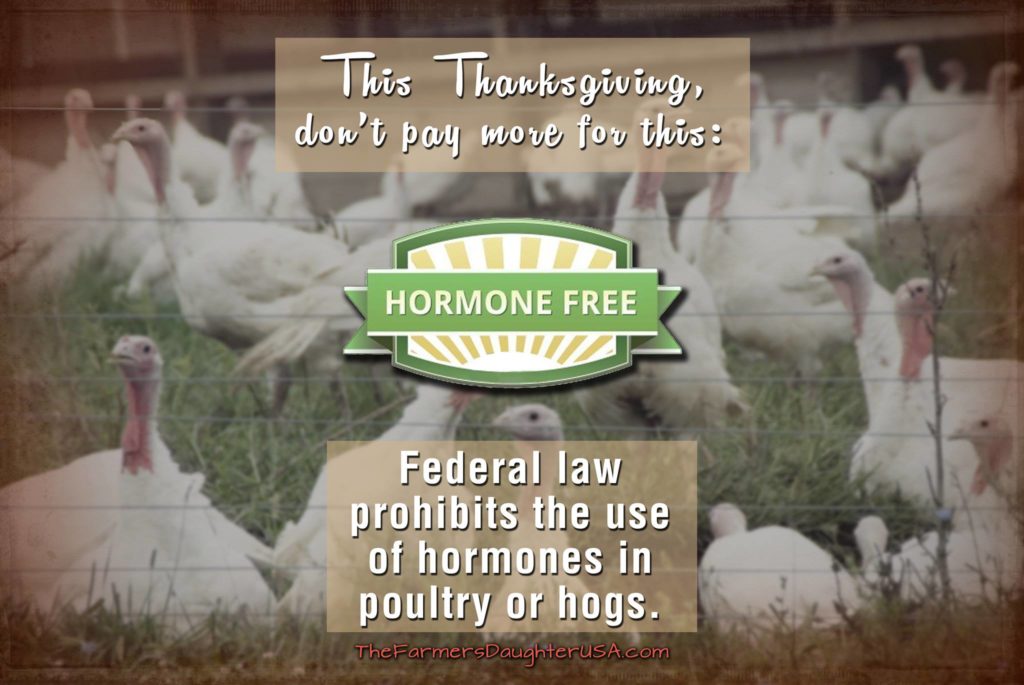
    Most of us are willing to pay more for a bird raised without added hormones, right? We want that thick, juicy breast meat, but don’t want biological repercussions within our own bodies.

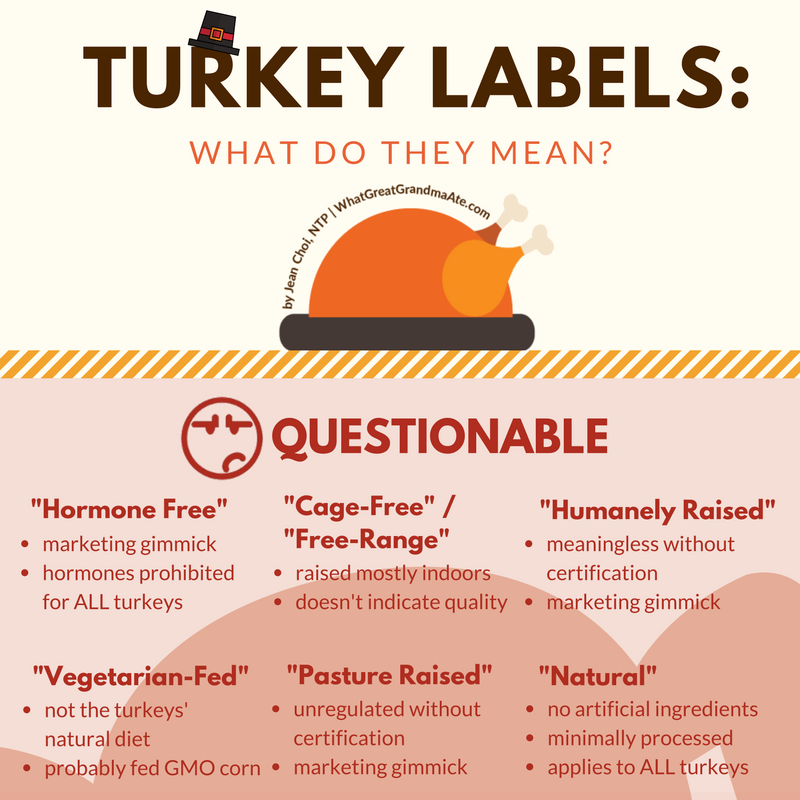
    What most of us don’t realize it’s illegal in the US to add hormones to poultry. Added hormones within our poultry is something we will probably never have to worry about. The packaging that says ‘no added hormones’ is simply a marketing ploy.
    Antibiotics

    An organic turkey is antibiotic free.
    Organic turkey farms use neither antibiotics nor feed that has not been certified organic.

    Turkeys may start out antibiotic-free, but farmers may medicate an entire flock if a few birds get sick. Some growers keep separate flocks, raising turkeys without antibiotics until problems occur, then moving sick birds to another pen if they have to medicate. Others must euthanize sick birds to keep the rest of the flock safe.

    An ongoing argument exists regarding the ethics of using antibiotics. While many farmers have announced that they will stop adding medication to daily feed, they hold that treating sick animals is the most humane way to raise meat. Eschewing all antibiotics means suffering of the animal, spread of disease, and euthanasia of sick animals before the other livestock can contract the illness.
    Injected Additives

    Self-basting or injected birds have been treated with a brine and/or a flavored injection to increase moisture retention and flavor. The fresh turkeys are injected with a basting solution made of salt water and “common household spices,”. Manufacturers are not required to share the specific ingredients/spices of their basting formula.

    Don’t let the “Natural” label fool you

    Unlike the word “organic” the word “natural” does not have a specific meaning and can mean many different things. In general, “natural” food does not contain artificial colors, flavors, sweeteners, preservatives or other additives. When you see the word “organic” on a label or a package that means the product was grown or made according to the strict standards (i.e. Without the use of toxic, persistent chemicals, GMOs, antibiotics or hormones) as established by the USDA.

    Summary of Organic vs Conventional

    Organic birds, one would imagine fields of open space with birds freely moving around. The use of synthetic fertilizers, pesticides, herbicides, irradiation, sewage sludge, hormones, antibiotics and genetic engineering is strictly prohibited. However, being organic does not guarantee they are free ranged.The appeal of free-range turkeys is that they are raised with access to outdoor space so they can roam — many folks believe that this makes for better tasting meat.

    Conventional broad breasted turkeys are in most cases caged, eat genetically modified grain, never see the light of day, and are given antibiotics, and injected with unknown solutions.

    Free-range and organic turkeys are often in high demand; so if you choose to get one, you should order it now (if you haven’t already). Whole Foods/Amazon has a sale through November 26. <Click ad below>


    THROUGH NOV 26, 2017


    Have you eaten heritage or organic turkeys? Did you notice a flavor difference? 


    Deciphering the Label Online RESOURCES:

    USDA guidelines for conventional/organic turkey
    https://www.fsis.usda.gov/wps/wcm/connect/2a9bcae8-ae1e-4248-9ce7-4e752f2f91fc/Turkey_Raised_by_the_Rules.pdf?MOD=AJPERES

    Label Guide: Food Network http://www.foodnetwork.com/healthyeats/healthy-tips/2009/04/eco-friendly-food-label-decoder

  • Weed killer found contaminating most popular US foods

    Weed killer found contaminating most popular US foods

    Picture

    FIND OUT WHAT’S IN YOUR FOOD!
    http://www.cornucopia.org/

    The old saying ‘you are what you eat’ is so true.
    The chemicals that are put on our food are ‘considered safe’ because they are so minute. However, they are cumulative and since most are not properly tested prior to release, we are seeing an unbelievable rise ailments. These chemicals have had time to build up also instead of dissipate like we were told they would once they were applied.
    For the last 20 years, these chemicals have had the chance to deplete our soils from so many nutrients. Our food is void of what we thought we were eating.
    NOVEMBER 2016

    Glyphosate is the world’s most widely used herbicide in agriculture and gardening. Several global scientific agencies have found the chemical is unlikely to cause cancer in people exposed to it through food. 

    Food Democracy Now!, a non-governmental organization, enlisted Anresco Laboratories to carry out the study. The food safety testing lab is registered with the U.S. Food and Drug Administration.

    Glyphosate food testing results, in parts per billion (ppb).

    Glyphosate food testing results, in parts per billion (ppb).

    IMAGE: FOOD DEMOCRACY NOW!

    Researchers found original Cheerios had the highest level of glyphosate compared to other foods tested, at about 1,123.5 parts per billion — or 1.125 milligrams of glyphosate per 1 kilogram of cereal. 

    On their own, those numbers seem meaningless. Who will realistically eat that much cereal in 24 hours, and do so day after day?

    However, since most people regularly eat a range of cereals and snack foods, their total exposure to glyphosate may be higher than results for a single item suggest. And the less you weigh, the more glyphosate you consume relative to your body weight, so toddlers munching on Cheerios have much higher exposure. 

    Monsanto’s glyphosate propaganda – a line which is parroted by the Monsanto-influenced FDA – holds that the substance poses no threat to humans and affects only plants.
    From Natural Health 365:
    “Scientists for Monsanto – the most hated corporation in the world – insist that glyphosate is safe because it targets a metabolic system called the shikamate pathway – which humans and animals lack. Yet the trillions of beneficial bacteria in the human digestive tract do have this pathway – and disrupting it can have catastrophic consequences.
    “In truth: Glyphosate harms critical beneficial bacteria, causing an overgrowth of pathogens, which in turn produce toxic phenols that cause inflammation … .”

    Glyphosate: a ‘wrecking ball’ to the human body

    Dr. Stephanie Seneff, an MIT senior research scientist and environmental toxins expert, is known for having documented the link between glyphosate and autism. She also believes that glyphosate is responsible for many other chronic diseases whose rates have soared in recent years, since the introduction of glyphosate. Dr. Seneff labels glyphosate as “the most significant chemical used today,” and one that has the effect of a “wrecking ball” on the human body.
    From Pompa:
    “Glyphosate is what Dr. Seneff calls a ‘monster molecule,’ and affects human biology in many ways. …
    “Dr. Seneff believes that glyphosate exposure is catapulting gluten sensitivity into epidemic proportions.”
    Aside from its effects on the gut, glyphosate has been linked to liver, kidney, pancreatic, thyroid and colon cancer – as well as ADHD, Alzheimer’s, birth defects, brain cancer, breast cancer, diabetes, heart disease, obesity, Parkinson’s, multiple sclerosis and more.
    Meanwhile, the EPA – another agency bribed into doing Monsanto’s bidding – continues to quietly raise the acceptable levels of glyphosate in our food supply. Fifty times the amount of glyphosate is now allowed on corn than was permitted in 1996, for example, and the total allowed amount has increased by a factor of 17.

    It’s time to get Monsanto’s Roundup off your plate, ban glyphosate and label GMOs! We need your help today. Every voice counts! The report can be viewed here.